Isle of Skye and the Hebrides
From Trotternish to the beaches of Harris and the Callanish stone circle, Scotland's westernmost archipelago combines spectacular geology with living Gaelic culture.
Skye has not truly been an island since 1995, when the bridge connecting it to Kyle of Lochalsh opened. This accessibility explains its summer crowds, but reveals nothing of its geology: the Trotternish peninsula in the north is one of Europe's largest landslide formations, and it is responsible for the Old Man of Storr and Quiraing. To the south, the Black Cuillin, a jagged gabbro massif, peaks at 992 metres at Sgùrr Alasdair and offers one of the UK's most technically challenging ridge traverses.
Portree, with 2,500 inhabitants, is the island's only true small town. Its colourful harborside houses serve as a logistics base: you'll find most accommodation, boat agencies for spotting white-tailed eagles on Loch Portree, and road connections to Trotternish in the north and Sleat in the south. The other villages—Dunvegan with its castle inhabited by the MacLeod clan since the 13th century, Carbost and its Talisker distillery, Elgol at the foot of the Cuillin—are linked by narrow single-track roads with passing places, which considerably slows the travel times announced by GPS devices.
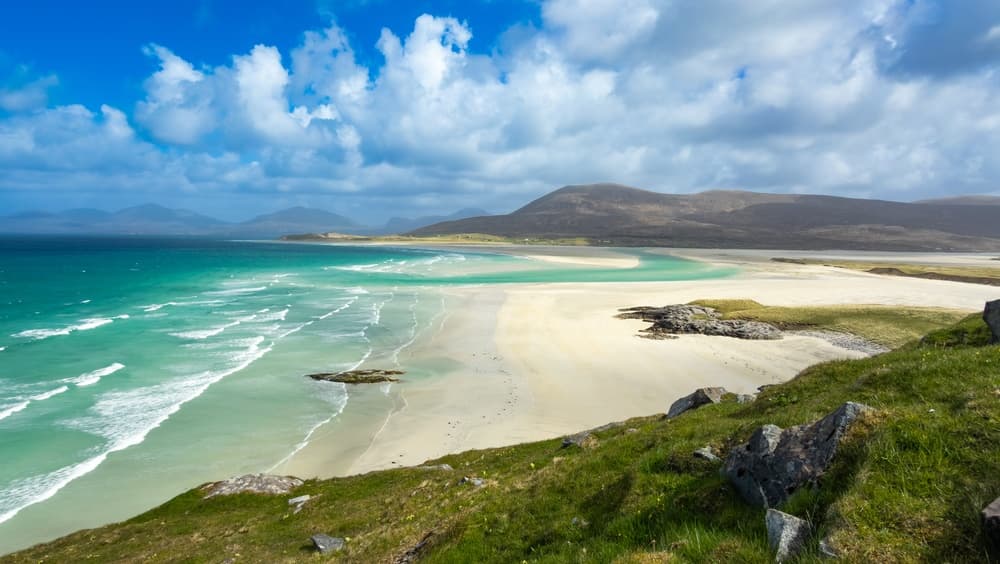
Beyond Skye, the Outer Hebrides form a 200-kilometre chain between Lewis in the north and Barra in the south. The CalMac ferry from Uig (north Skye) reaches Tarbert on Harris in 1 hour 40 minutes, while the one from Ullapool on the mainland reaches Stornoway on Lewis in 2 hours 30 minutes. These are flat, peaty islands in the north, mountainous at Harris, framed to the west by white shell-sand beaches—Luskentyre, Scarista, Seilebost—that radically shift how you perceive Écosse.
Gaelic culture remains alive here. On Lewis and Harris, nearly 60% of residents still speak Gàidhlig daily, road signs are bilingual, and on Sundays, on Lewis, Presbyterian observance remains strict: shops closed, transport reduced, ferry crossings cancelled. Harris tweed, hand-woven in artisans' homes according to a 1993 law, is found in workshops in Tarbert and Plocrapool. At Callanish on Lewis, the stone circle dates to around 2900 BCE, predating Stonehenge, and its cross arrangement has no equivalent in European megaliths.
The local economy rests on extensive sheep farming (crofting, small family holdings), lobster and scallop fishing, tourism, and on Lewis, peat and tweed industries. Gastronomy reflects this foundation: Sconser langoustines, Uig smoked salmon, Hebridean lamb, raw-milk Connage cheeses. The distilleries are Talisker on Skye, Harris in Tarbert (gin and young single malt), and Abhainn Dearg on Lewis.
The climate is pure oceanic. The latitude (57–58° north) imposes 18-hour days in June and 6-hour days in December. Wind blows constantly from the Atlantic, and rainfall reaches 2,200 mm per year on the Cuillin, versus 1,100 mm in Stornoway. This wind, which clears mists in minutes, also makes the light so changeable: on Harris's beaches, you can experience four types of weather in two hours.
To discover
Trotternish peninsula, north Skye. 80 km loop from Portree via Old Man of Storr (1-hour climb each way), Kilt Rock, Quiraing with its 4 km ledge walk, and return via Uig. Best done early morning to avoid tour buses.
Harris beaches. Luskentyre and Scarista form a 5 km white sand bar facing the turquoise waters of the Sound of Taransay. Water remains 12–14°C in August, wind is constant, human footprints rare outside July.
Callanish stone circle, Lewis. 13 gneiss monoliths arranged in a cross around a central cairn, erected around 2900 BCE. Free access, no barriers. The site is usually empty after 5 pm.
Uig to Tarbert ferry crossing. 1 hour 40 minutes of sailing through the Little Minch, with regular sightings of common dolphins and, in summer, minke whales. Booking essential from May to September; car included.
Berneray and causeway to North Uist. Small 6 km² island connected by causeway to North Uist, deserted western beaches, former SYHA hostel set in traditional thatched cottages. A useful step for slowing the pace.
When to go
The most stable window opens mid-May to mid-June: long days (sunrise 4:30 am, sunset 10 pm in June), temperatures 12–17°C, still moderate rainfall (90 mm in May in Portree versus 170 mm in January), and midges are not yet active. September is a second interesting window, windier but bright, with heather blooming on Lewis. July and August remain viable but combine three drawbacks: high crowds on Skye (car parks full at Storr and Fairy Pools by 9 am), aggressive midges especially at Sligachan and in wetland areas, and accommodation requiring 6–8 months' advance booking.
From November to March, many small hotels and restaurants close, ferries to the Outer Hebrides are frequently cancelled due to winds exceeding 60 km/h, and days shrink to 6–7 hours of daylight. The Cuillin becomes snow-covered from December to April. This season suits travellers comfortable with flexible schedules and storm-driven rather than visit-oriented itineraries.
Practical advice
Allow 4 days minimum on Skye alone, staying 2 nights in Portree and 1–2 nights on the south side (Sleat or Broadford) to avoid retracing your route. To include the Outer Hebrides, add at least 4 days: 1 night on Harris, 2 on Lewis, the rest in inter-island ferry transitions. The smoothest logic is to enter via the Skye bridge from the central Highlands, cross at Uig to Harris, descend the archipelago to South Uist or Barra, then return by ferry to Oban on the mainland. The nearest air entry point is Inverness (2.5 hours' drive to Skye) or Glasgow (5 hours).
The region pairs naturally with the central Highlands (Glen Coe, Fort William) and the northwest coast, which shares the same Lewisian gneiss geology and completes the picture of far-west landscapes. Comfort is uneven: Skye has a few good-quality hotels (Three Chimneys, Kinloch Lodge), but the Outer Hebrides operate mainly through family B&Bs and simple guesthouses. This region suits hikers, lovers of raw landscapes, and contemplatives ready to let weather dictate daily rhythms. For families with young children, ferry logistics and the length of single-track driving require advance planning of pace.