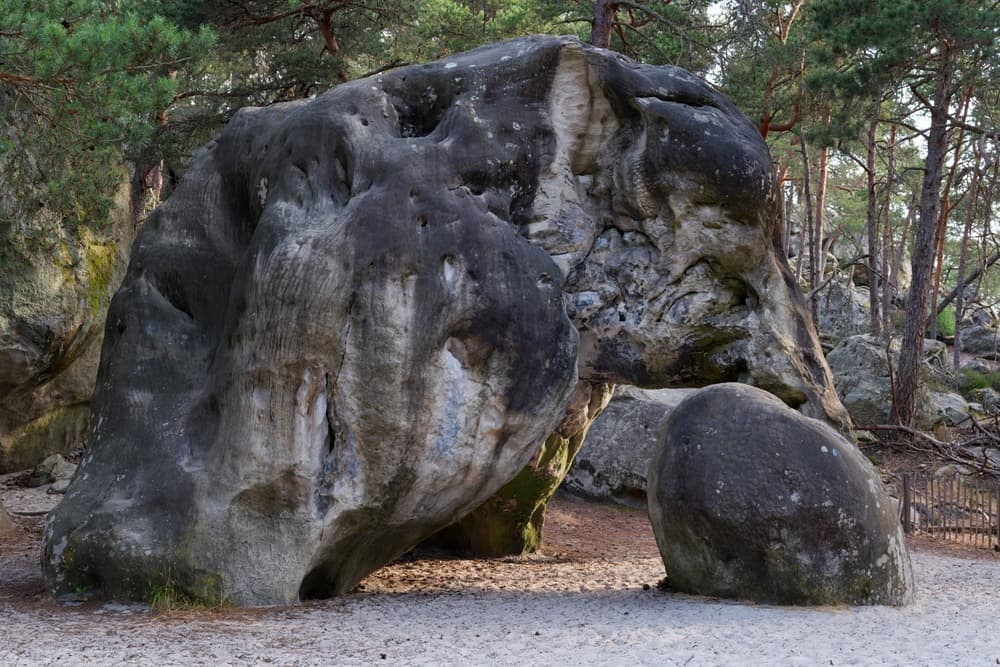
Elephant of Larchant
Elephant of Larchant
The Elephant of Larchant is a sandstone rock formation shaped by erosion, its silhouette evoking a pachyderm. Freely accessible on foot from the medieval village of Larchant in Seine-et-Marne.
At the heart of the medieval village of Larchant, in Seine-et-Marne, stands a geological curiosity nicknamed the "Elephant": a chaos of sandstone shaped by erosion into a silhouette evoking the head and trunk of a pachyderm. This emblematic rock, nestled within the Fontainebleau forest, attracts walkers, climbers and geology enthusiasts seeking an authentic detour away from well-trodden paths.
Essential practical information
- Access: outdoor natural site, accessible on foot from the village of Larchant.
- Entry: free.
- Recommended duration: 1 to 2 hours combining the walk with the village.
- What to wear: hiking shoes recommended, rocky and sometimes slippery terrain.
What to see
The Elephant is a block of Fontainebleau sandstone sculpted by millions of years of wind and water erosion. Its anthropomorphic form — trunk tilted toward the ground, imposing mass — is legible from several angles. Around it, other rocks with equally singular silhouettes dot the moorland and pines, forming a mineral landscape characteristic of the massif.
History and context
The Fontainebleau sandstones formed during the Tertiary Era, some 30 million years ago, through the cementation of marine sands. Differential erosion subsequently isolated the hardest blocks, creating these rocky chaoses. Larchant, a village documented since the Middle Ages, also boasts a remarkable Gothic collegiate church, making it doubly interesting for visitors.
Highlights of the visit
The rock viewed head-on
The frontal angle, from the main path, offers the clearest reading of the animal silhouette. Raking light at dawn or dusk accentuates the reliefs and hollows of the sandstone.
The surrounding chaos
Beyond the Elephant, the area holds other blocks with evocative forms. A brief exploration on foot reveals this landscape of sandy moorland and Scots pines, typical of the margins of the Fontainebleau massif.
The village of Larchant
A few minutes' walk away, the collegiate church of Saint-Mathurin — a 13th-century Gothic edifice whose bell tower remains unfinished — merits a stop. The village retains a preserved rural character.
Photography tips
Favour morning light or late-day sun for pronounced shadows that reveal the sandstone's texture. Step back far enough to frame the entire rock with some vegetation in the foreground. Avoid harsh overhead light: flat illumination erases relief. No known photographic restrictions apply to this public natural site.
Location and access
Larchant is located in Seine-et-Marne (77), at the south-western edge of the Fontainebleau massif. The village is accessible by car from Nemours or La Chapelle-la-Reine. The Elephant is reached on foot from the village centre via marked paths. Rocky and sandy terrain makes access difficult for people with reduced mobility.
Nearby attractions
- Collegiate Church of Saint-Mathurin in Larchant — medieval Gothic edifice a stone's throw away, featuring an imposing nave and an unfinished bell tower.
- Fontainebleau Forest — classified forest massif, dotted with rocky formations, hiking trails and renowned climbing sites.
- Franchard Gorges — wild sector of the massif, prized for its rocks and tranquility.
Frequently asked questions
From the centre of Larchant village, marked paths lead to the rock on foot. Car remains the most practical means to reach Larchant, located in Seine-et-Marne.
No, the site is outdoors and access is entirely free.
Hiking shoes are essential: the terrain is rocky, sandy and can be slippery after rain.
Yes. The collegiate church of Saint-Mathurin, in the village itself, is easily visited in the same half-day. The Fontainebleau massif offers numerous possible extensions.
The site is accessible year-round. Spring and autumn offer favourable light and pleasant temperatures for walking.

Photos
Interested in this visit?
We can include it in your personalised itinerary.