Grenoble
Grenoble
Grenoble, at the confluence of the Isère and Drac rivers, blends historical heritage, world-class museums and immediate access to Alpine massifs. The Bastille, the Grenoble Museum and the old town form a dense itinerary to explore in two to three days.
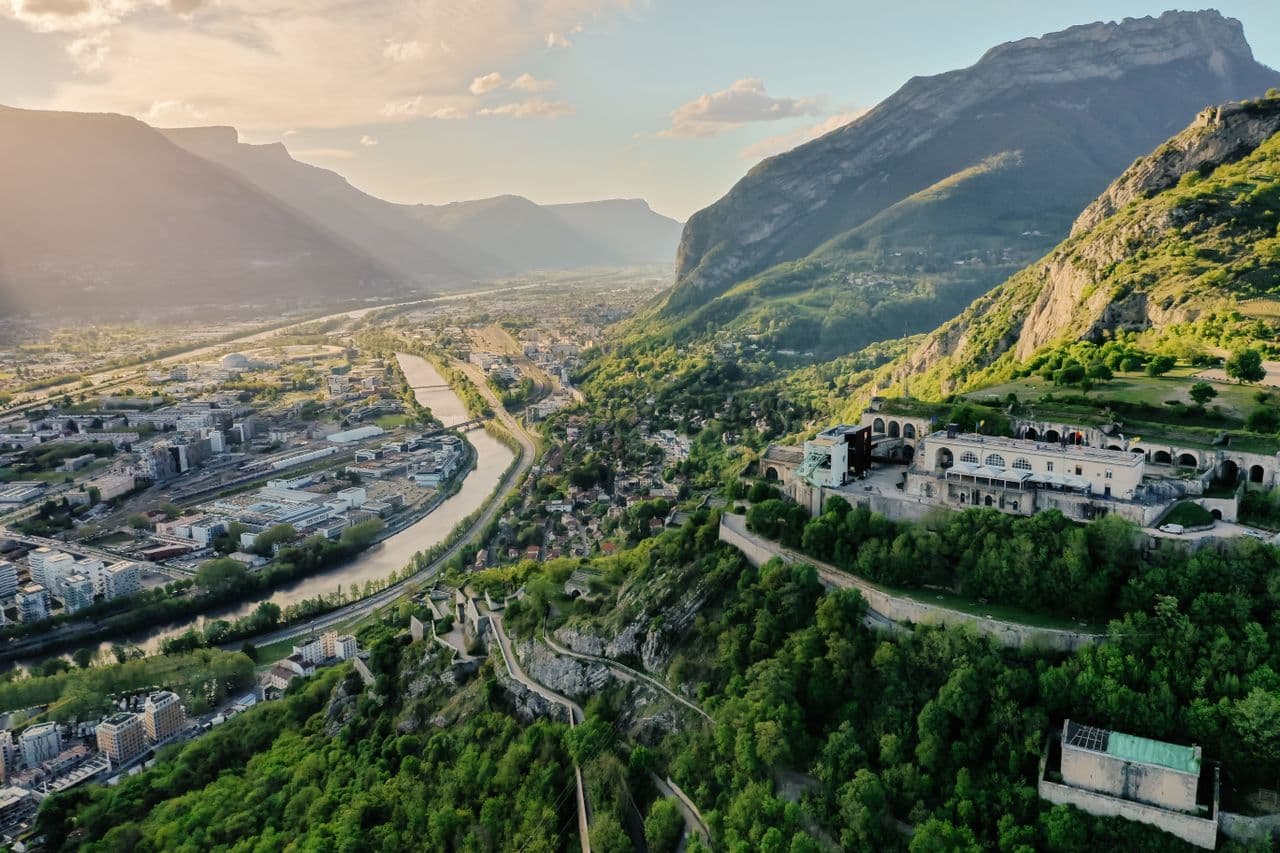
Grenoble sprawls at the confluence of the Isère and Drac rivers, encircled by three massifs: Belledonne, Vercors and Chartreuse. Capital of Isère and a leading university city, it combines historical heritage, a rich cultural scene and direct access to the mountains. Its compact centre is best explored on foot or by bike, while the Bastille watches over the entire agglomeration from its heights.
Practical Information at a Glance
- Access: Grenoble SNCF railway station well served from Paris (TGV), Lyon and Marseille; Grenoble-Alpes Isère airport approximately 45 km away.
- Urban transport: TAG network (trams and buses) covers the entire agglomeration; Métrovélo bike-sharing available.
- Recommended duration: 2 to 3 days to combine city, museums and a mountain excursion.
- Accessibility: city centre mostly flat, accessible trams; the Bastille is accessible by cable car.
What to See
The historic heart revolves around place Grenette and place Notre-Dame, lined with colourful facades. The Grenoble Museum houses one of France's richest fine art collections, from Italian primitives to contemporary works. The Bastille, a 19th-century fortress perched at 476 m, offers a 360° panorama over the Alps.
The Saint-Laurent neighbourhood, on the right bank of the Isère, preserves Early Christian archaeological remains visible in the archaeological museum. The Jardin de Ville and the landscaped banks of the Isère provide breathing spaces at the heart of the city.
History and Context
A former Gallo-Roman Cularo, the city took the name Gratianopolis under Emperor Gratian in the 4th century, later contracting to Grenoble. Capital of the Dauphiné, it hosted the first provincial parliament in 1453. The Day of the Tiles in 1788 made it a symbol of the prelude to the French Revolution. In the 20th century, the 1968 Winter Olympics accelerated its modernization and international prominence.
Highlights of Your Visit
The Bastille and Its "Bubbles"
The Bastille cable car, nicknamed "the bubbles" for its transparent spherical cabins, connects Quai Stéphane-Jay to the fort in just minutes. From the terraces, your gaze embraces the three Alpine massifs and the Isère plain. Hiking trails depart directly from the fort towards Vercors or Chartreuse.
The Grenoble Museum
Founded in 1798, it is one of France's first public museums. Its collection spans seven centuries of European painting — Rubens, Zurbarán, Matisse, Picasso — and a notable Egyptian archaeological section. The contemporary building, opened in 1994, incorporates in situ works by Richard Serra and Sol LeWitt.
The Saint-Laurent Neighbourhood and Archaeological Museum
Beneath the Saint-Laurent church lie superimposed archaeological layers from the 4th to 12th centuries: Early Christian baptistry, Merovingian crypt, Romanesque chapels. The guided tour illuminates fifteen centuries of urban history in a single site.
Place Saint-André and the Parlement Palace
Place Saint-André concentrates two major monuments: the Saint-André collegiate church (13th century), former chapel of the Dauphins, and the Parlement Palace of the Dauphiné (15th-16th century), whose Flamboyant Gothic facade is remarkably well preserved.
Photography Tips
- Bastille: golden light in late afternoon on the massifs; sunrise for clear views without haze.
- Reflections on the Isère: from Saint-Laurent bridge, in blue hour, with the illuminated Bastille in the background.
- Coloured rooftops: the ochre and pink facades of the historic centre stand out under raking morning light.
- No known photography restrictions in public spaces; check rules specific to each museum at the entrance.
Location and Access
Grenoble is located approximately 100 km south-east of Lyon and 560 km from Paris. The central station is a 10-minute walk from place Grenette. The tramway network (lines A, B, C, D, E) serves the main sites. For the Bastille, the cable car departure point is at Quai Stéphane-Jay, accessible on foot from the centre in less than 15 minutes.
Ski resorts in the Vercors (Villard-de-Lans, Autrans) and Chamrousse are accessible in less than an hour by road.
Nearby
- Vercors — limestone plateau with spectacular gorges, ideal for hiking and cross-country skiing.
- Chartreuse Massif — dense forests and the Grande Chartreuse monastery, birthplace of the eponymous liqueur.
- Chamrousse — ski resort heir to the 1968 Olympics, accessible directly from Grenoble.
- Château de Vizille — 17th-century residence and museum of the French Revolution, about twenty kilometres to the south.
- Gorges du Nan — canyon set into the Vercors, accessible by car from Grenoble.
Frequently asked questions
Spring (April-June) and autumn (September-October) offer pleasant weather for the city and hiking. Winter is ideal if you combine urban exploration with skiing in the nearby massifs.
The cable car ("the bubbles") is the quickest way from Quai Stéphane-Jay. Several hiking trails also allow ascent on foot from the city centre.
The Grenoble Museum charges admission for permanent collections, with reduced rates and free entry depending on age and status. Check exact conditions on the official website before your visit.
Yes. The historic centre is compact and flat, perfect on foot or by bike. The tram network covers the agglomeration. For surrounding massifs, a car or seasonal shuttles are necessary.
Two days are sufficient for major sites (Bastille, Grenoble Museum, old town). Plan a third day for an excursion to Vercors or Chartreuse.
Yes. The Bastille cable car, urban parks and proximity to ski resorts make it a family-friendly destination year-round.
Want to discover this destination?
Our local advisors design your tailor-made trip.