Mont Blanc
Mont Blanc
At 4,808 meters, Mont Blanc dominates the Franco-Italian Alps. From Chamonix, cable cars and mountain railways open the massif to all levels, from families to seasoned climbers.
Mont Blanc rises to 4,808 meters, the highest point in the Alps and Western Europe. Straddling the Franco-Italian border, it dominates the Chamonix valley from its French side. A massif of ice, granite and eternal snow, it attracts seasoned alpinists, hikers and casual visitors come to contemplate a high-altitude panorama among the continent's most striking vistas.
Essential information at a glance
- Public access: cable car to Aiguille du Midi from Chamonix (two sections) — the summit itself is only accessible via mountaineering.
- Recommended duration: half-day for Aiguille du Midi; several days for a full climb.
- What to wear: warm clothing and wind-resistant layers essential even in summer at Aiguille du Midi (3,842 m).
- Accessibility: the panoramic terrace at Aiguille du Midi is partially accessible; the summit is not.
- Season: cable car open year-round weather permitting; mountaineering ascents primarily June-September.
What you'll see
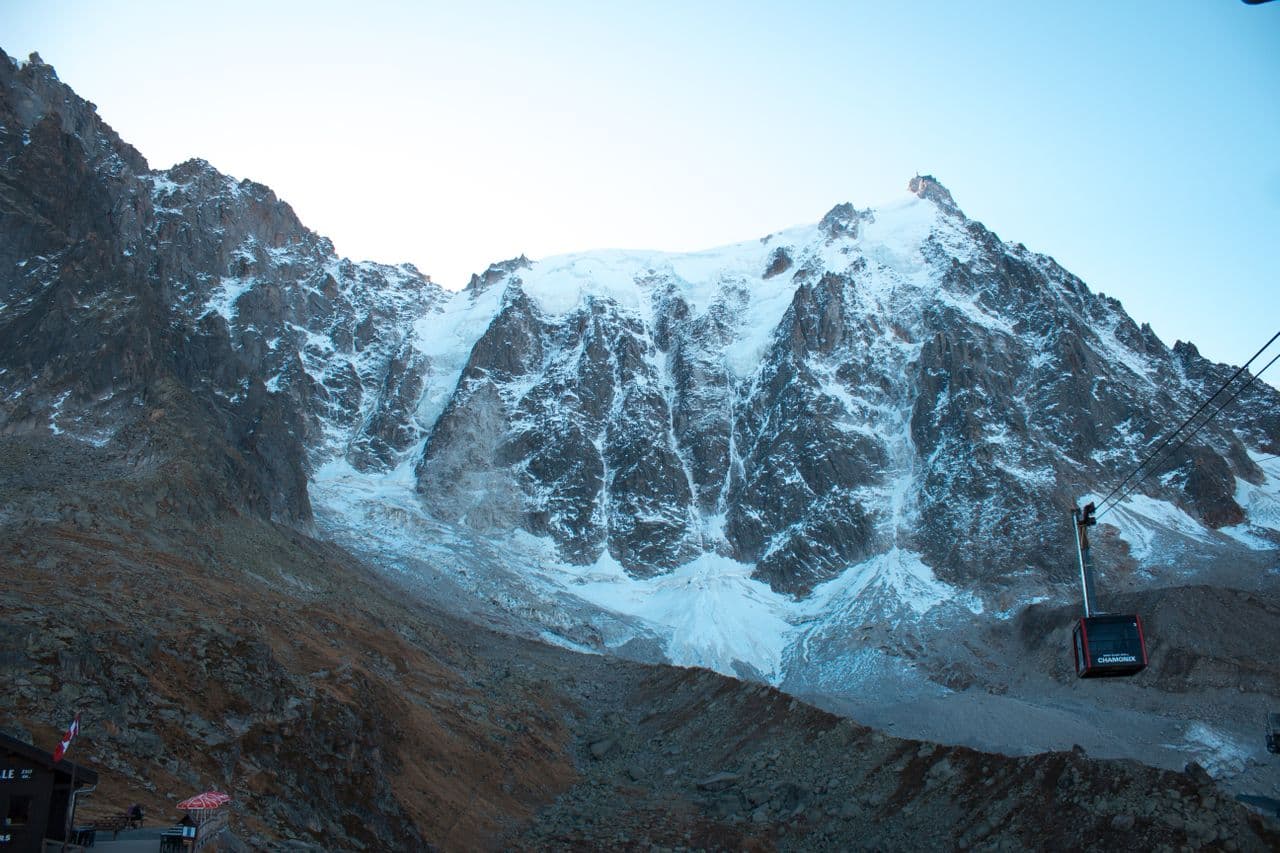
From the Aiguille du Midi summit, your eye stretches across Mont Blanc's snowy dome, the Mer de Glace — France's largest glacier — and a horizon of peaks extending to the Matterhorn and Jungfrau on clear days. The Chamonix valley stretches 2,800 meters below. Alpinists reaching the summit cross the Bosses ridge, the final exposed passage before the culminating point.
History and context
The first ascent took place on August 8, 1786, by Jacques Balmat and physician Michel-Gabriel Paccard, from Chamonix. The event marks the birth of modern mountaineering. Horace-Bénédict de Saussure, a Genevan naturalist, had offered a prize to encourage exploration of the massif and reached the summit himself in 1787. Since then, Mont Blanc has been climbed hundreds of thousands of times, yet remains a serious undertaking with a significant accident rate.
Highlights of your visit
Aiguille du Midi
The cable car from Chamonix is the most spectacular panoramic access to the massif. At 3,842 meters, the terrace offers a direct view of the summit dome. The « Step into the Void » — a glass-floored cabin cantilevered over the edge — lets you stand above 1,000 meters of rock face.
Mer de Glace
Accessible by the Montenvers rack railway from Chamonix, this 7-kilometer-long glacier is France's largest. An ice cave carved into the glacier lets you observe its interior. The glacier's retreat, visible on historical markers carved into the rock, strikingly illustrates climate change.
Mountaineering ascent
The normal route passes through the Goûter refuge (3,835 m) or Tête Rousse refuge. It demands excellent physical condition, a high-altitude guide and complete equipment. Weather and conditions in the Goûter couloir — a rockfall zone — determine every departure.
The panorama from Brévent or Flégère
These stations on the opposite side of the valley offer a frontal view of the entire Mont Blanc range, ideal for photographing the massif in its entirety without being part of it.
Photography tips
Golden morning light illuminates Mont Blanc's French side from Brévent or Chamonix's heights. At sunset, the dome takes on a rosy hue — the phenomenon known as « alpenglühen. » From Aiguille du Midi, shoot early: clouds often blanket the massif by mid-morning. Drones are prohibited within the Massif des Bauges regional natural park perimeter and subject to strict regulations in mountain zones.
Location and access
Mont Blanc sits on the border between Haute-Savoie (France) and Val d'Aosta (Italy). The French base is Chamonix-Mont-Blanc, reachable from Geneva (roughly 1 hour by car) or by Mont-Blanc Express train from Saint-Gervais. The Mont Blanc tunnel connects Chamonix to Courmayeur on the Italian side. Chamonix-Mont-Blanc station is in town center, a few minutes' walk from the cable car stations.
Nearby spots accessible by cable car or on foot from Chamonix: Aiguille du Midi, Mer de Glace, Le Brévent.
Nearby attractions
- Aiguille du Midi — viewpoint at 3,842 m, starting point for glacier routes and the Vallée Blanche.
- Mer de Glace — France's largest glacier, accessible by the Montenvers rack railway.
- Chamonix-Mont-Blanc — historic hub of mountaineering, with alpine museum and numerous outfitters.
- Courmayeur — the massif's Italian side, reachable through the Mont Blanc tunnel, Italian alpine charm.
- Lac Blanc — alpine lake reflecting Mont Blanc's massif, reachable on foot from La Flégère.
Frequently asked questions
No. The Aiguille du Midi cable car allows any visitor to reach 3,842 meters and observe the summit dome without technical skill. Summiting itself requires experience, a guide and specialized equipment.
Summer (July-August) offers the best conditions for hiking and mountaineering. Winter attracts skiers to Chamonix's slopes. The Aiguille du Midi cable car operates year-round, weather permitting.
Even in mid-summer, temperatures at 3,842 meters can hover around freezing or below. Bring a warm jacket, a wind-resistant layer and closed-toe shoes. Mountain sickness can affect people sensitive to this altitude.
Yes. The Mont Blanc tunnel links Chamonix to Courmayeur in minutes. The Skyway Monte Bianco, an Italian cable car, offers a different viewpoint of the massif from Courmayeur.
Photography is free for personal use across the entire massif. Drone use is subject to strict mountain-zone regulations and generally prohibited without prefectural authorization.
Allow half a day for Aiguille du Midi (journey + terrace + descent). Add a half-day for Mer de Glace via Montenvers. A full day lets you combine both with a break in Chamonix.
Want to discover this destination?
Our local advisors design your tailor-made trip.