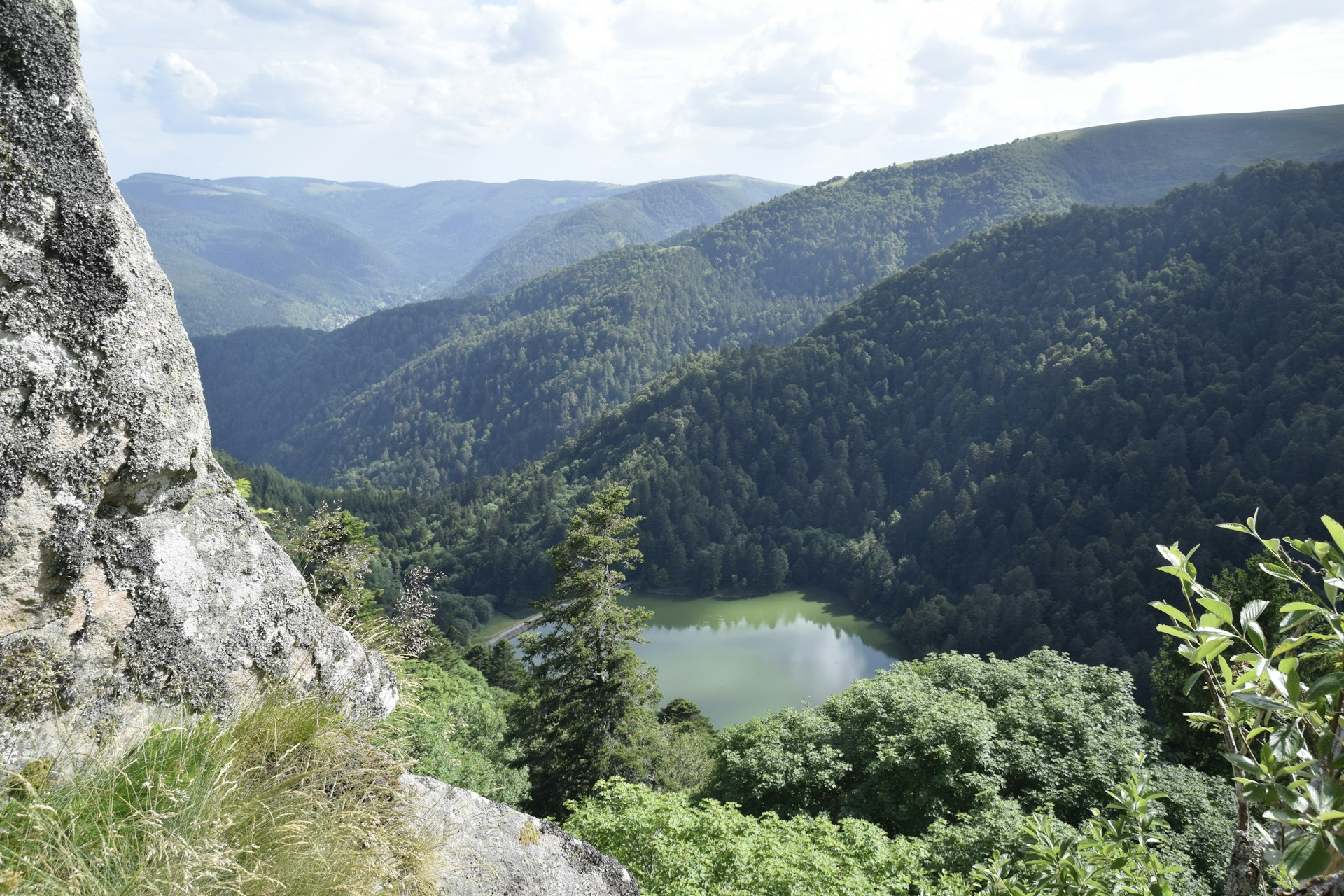
Petit Ballon Massif
At 1,272 m elevation, Petit Ballon combines panoramic views over the Alsatian plain, Vosges forests, and farm-inns where you can taste traditional Munster cheese. An accessible peak, less crowded than its neighbor Grand Ballon.
Petit Ballon (1,272 m) is a peak in the Alsatian Vosges, nestled between the Guebwiller and Munster valleys. Less frequented than the nearby Grand Ballon, it offers sweeping panoramas across the Alsatian plain, the Rhine, and on clear days, the Alps. The massif blends fir forests, high-altitude alpine meadows, and typical Vosges farm-inns, the marcairies, where you can enjoy farmhouse Munster cheese and local charcuterie.
Practical Information at a Glance
- Access: from Munster (D10 toward Wasserbourg then forest road) or from Guebwiller via D40; parking at Petit Ballon pass.
- Admission: free (public natural space).
- Recommended duration: half-day to full day depending on the route chosen.
- What to wear: hiking boots recommended; warm clothing even in summer (frequent wind at the summit).
- Accessibility: the summit is not accessible by wheelchair; access roads allow you to reach the pass by car.
What to See
At the summit, the chaumes — wind-swept alpine meadows — open onto a 360-degree panorama. On clear days, your gaze can reach the Bernese Alps. Vosges forests of beech and fir trees cover the slopes. Herds of dairy cattle graze in summer around the marcairies, summer farms that produce AOC-protected Munster cheese.
History and Context
The Petit Ballon alpine meadows have been shaped since the Middle Ages by pastoral farming. Monks from Alsatian abbeys cleared the summits to establish pastures. The ridge once marked the boundary between the bishoprics of Strasbourg and Basel. During World War I, the Vosges massif formed the Franco-German front line; a few trench remnants still remain in the surrounding forests.
Highlights of Your Visit
The Summit Panorama
On fair weather days, the Alsatian plain, the Rhine, and the Black Forest unfold to the east. To the west, Vosges valleys sink into darker relief. The sunrise from the summit is particularly striking in autumn.
The Marcairies
These high-altitude farm-inns serve traditional meals: farmhouse Munster cheese, Vosges pie, homemade charcuterie. Some are open from May to October. It's a chance to buy cheese directly from the producer.
Hiking Trails
The GR 5 and several marked trails by the Club Vosgien traverse the massif. Routes connect Petit Ballon to Grand Ballon (1,424 m, the Vosges' highest peak) and surrounding passes. The ridge offers a linear hike accessible to regular walkers.
Photography Tips
Golden morning and evening light reveals the contours of the alpine meadows. In autumn, the contrast between russet beech trees and dark firs is particularly photogenic. For panoramic shots of the plain, favor mornings before mist rises. No photographic restrictions on this public natural site.
Location and Access
Petit Ballon sits at the border of Haut-Rhin and Vosges departments, about 20 km west of Colmar and roughly fifteen kilometers from Munster. The Route des Crêtes (D430) runs along the massif and easily connects the various Vosges peaks. No regular public transport to the summit; car or bicycle (demanding road) are practical options.
Nearby
- Grand Ballon — Vosges' highest peak, accessible from Route des Crêtes, with monument and panoramic view.
- Munster — valley town renowned for its AOC cheese and weekly market.
- Route des Crêtes — panoramic route linking Vosges peaks from Cernay to Sainte-Marie-aux-Mines.
- Lac de la Lauch — peaceful mountain lake in the Guebwiller valley, ideal for a break after hiking.
- Guebwiller — town with Alsatian architectural heritage, gateway to the Lauch valley.
Frequently asked questions
May to October to enjoy lush alpine meadows and open farm-inns. Autumn offers remarkable forest colors. In winter, the summit is snow-covered and roads may be closed or require special equipment.
Yes, by car via Route des Crêtes, both peaks are less than 30 minutes apart. On foot, the ridge hike between them is lengthy and requires good fitness.
Several marcairies (farm-inns) operate during summer season around the massif. They serve traditional Vosges meals. It is advisable to check their opening before departure, as hours vary by operator.
Trails around the pass are accessible to families with fit children. The summit itself presents no particular hazard, but wind can be strong. Pack warm clothing even in summer.
There is no regular public transport link to the summit. From Munster or Guebwiller, accessible by train, expect a long hike or bike ride uphill. Carpooling is a practical alternative.
The massif has no developed ski area comparable to major resorts. In snowy winters, snowshoeing and cross-country skiing are practiced on the alpine meadows, but facilities remain modest.
Want to discover this destination?
Our local advisors design your tailor-made trip.