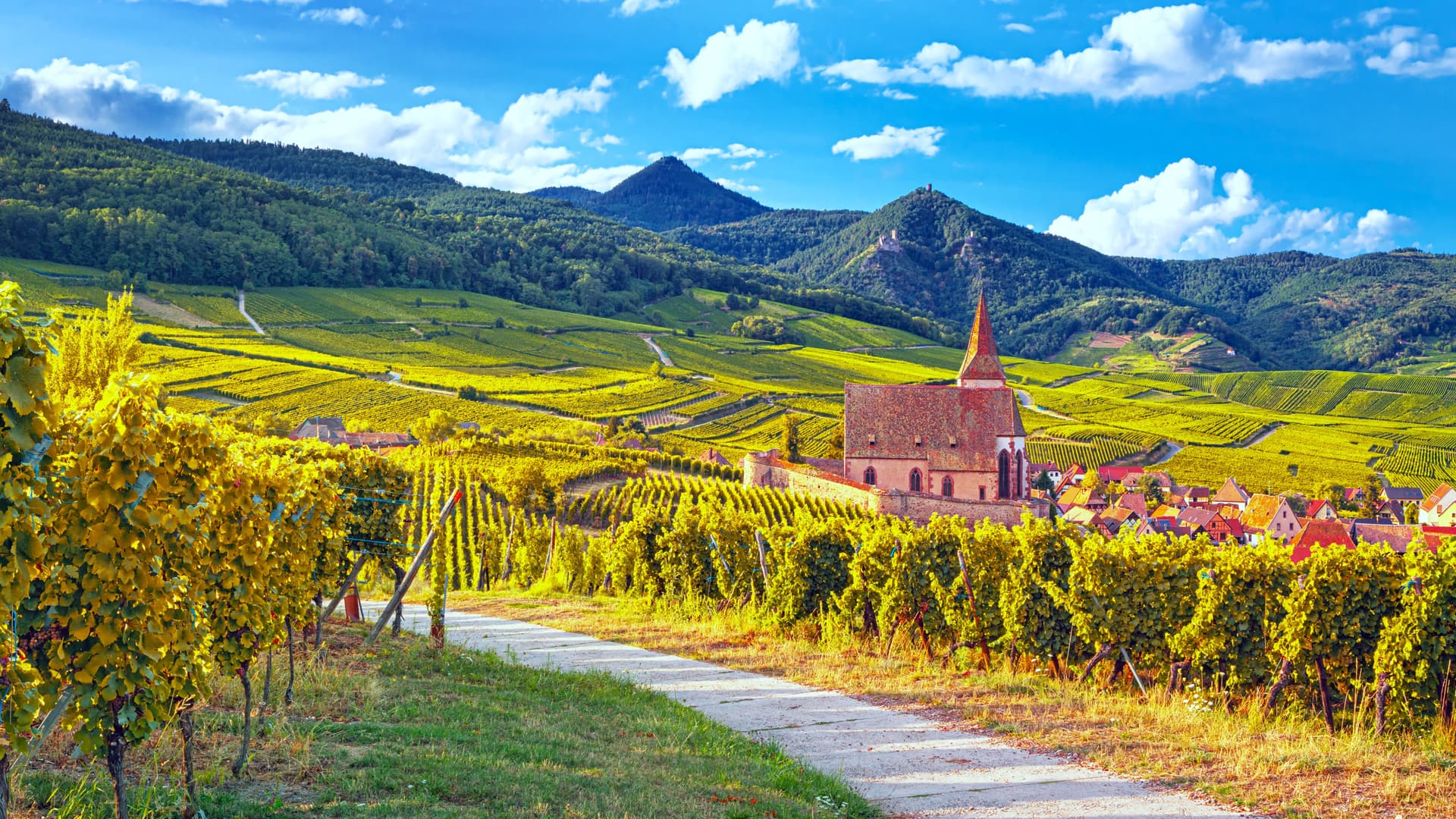
Alsace
Nestled between the Vosges and the Rhine, Alsace blends medieval villages, the Wine Route, and Franco-German architecture. Strasbourg, Colmar, and some sixty wine-growing towns compose one of the richest itineraries in northeastern France.
Alsace stretches between the Rhine and the Vosges in northeastern France. Terraced vineyards, half-timbered villages, Gothic cathedrals, and generous cuisine: this region embodies a distinctive identity shaped by centuries of Franco-German history. Strasbourg is its European capital; Colmar, its best-preserved medieval heart. The Wine Route connects the two across more than 170 km of landscapes and open cellars.
Practical Information at a Glance
- Access: TGV Paris-Strasbourg in 1 hour 47 minutes. Strasbourg-Entzheim airport with European connections. A35 motorway (north-south axis).
- Best time to visit: May-June when vines are in bloom; September-October during harvest season; late November-December for Christmas markets.
- Recommended duration: 4 to 7 days to cover Strasbourg, Colmar, and the Wine Route.
- Language: French; Alsatian (a Germanic dialect) remains present in villages.
- Currency: euro.
What to See
The region divides into three main zones. Bas-Rhin (north) is home to Strasbourg, Petite France, and the European Parliament. Haut-Rhin (south) concentrates Colmar, Riquewihr, Eguisheim, and the grand cru vineyards. The Alsatian Vosges offer fir forests, mountain lakes, and ruined châteaux perched on ridge crests.
History and Context
Alsace changed sovereignty four times between 1871 and 1945, alternating between France and Germany. This dual heritage explains the half-timbered architecture, bilingual street names, and a gastronomy that blends choucroute, baeckeoffe, and flammekueche with wines akin to German Riesling. Strasbourg, seat of the Council of Europe since 1949, embodies this Franco-German dialogue today.
Must-See Highlights
The Alsace Wine Route
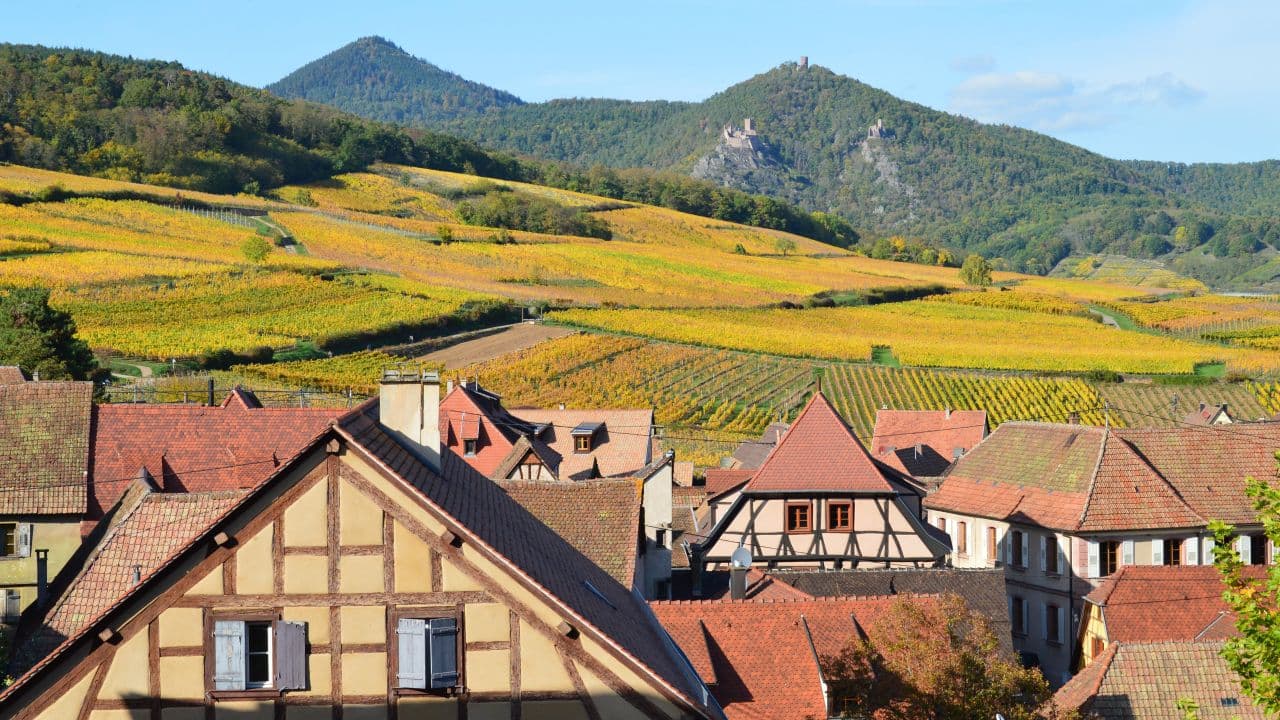
Established in 1953, it runs from Marlenheim to Thann across approximately 170 km. It passes through some sixty wine-growing villages. Leading appellations — Riesling, Gewurztraminer, Pinot Gris — are tasted directly in producers' cellars. Riquewihr and Ribeauvillé are the most photographed stops.
Strasbourg and the Grande Île
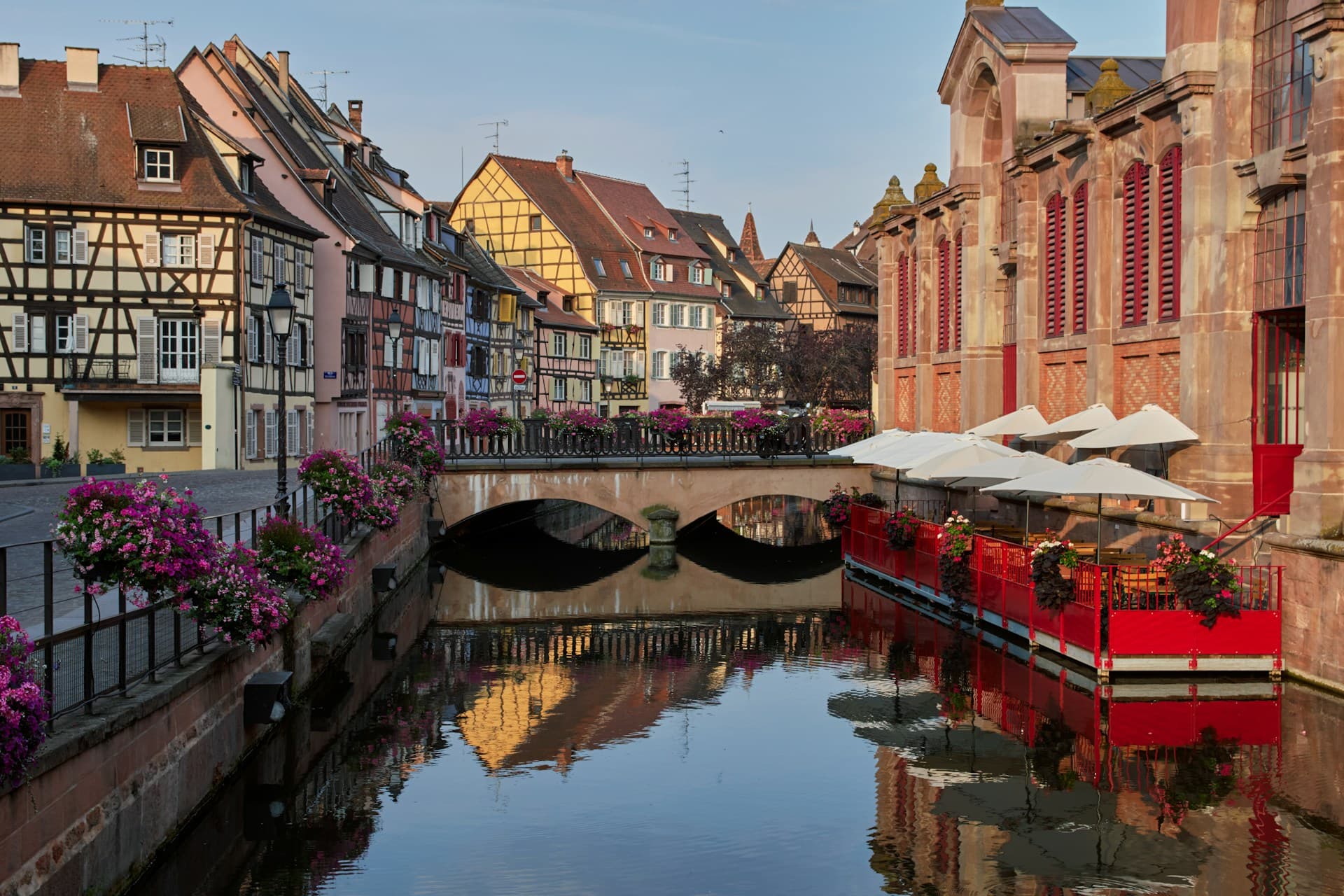
The historic center, a UNESCO World Heritage site since 1988, revolves around the Notre-Dame Cathedral in pink sandstone. Petite France, with its tanners' houses along the Ill, is the most emblematic quarter. The Alsatian Museum and the Modern Art Museum round out a visit.
Colmar and Its Medieval Heart
Colmar escaped bombing in World War II. Its center preserves intact Renaissance and Gothic facades. The Unterlinden Museum houses Grünewald's Isenheim Altarpiece, one of the major works of 16th-century European painting.
The Vosges Châteaux
More than 60 medieval châteaux line the Vosges ridge. Haut-Kœnigsbourg, restored in the early 20th century, is the most visited. Ortenbourg, Ramstein, and Andlau offer wilder ruins, accessible on foot from villages.
Christmas Markets
Strasbourg's Christkindelsmärik is one of Europe's oldest Christmas markets, documented since 1570. Colmar, Kaysersberg, and Ribeauvillé hold their own markets in December, often set against half-timbered village backdrops.
Photography Tips
- Petite France (Strasbourg): golden light early morning before crowds arrive. Reflections on the Ill from the covered bridges.
- Riquewihr: Rue du Général-de-Gaulle in blue hour with lanterns lit and no cars.
- Vineyards: late September to early October, leaves turn red and gold — ideal for wide shots from the ridges.
- Haut-Kœnigsbourg: autumn morning mist, views across the Rhine plain from the crenellations.
Location and Access
Alsace borders Germany to the east (Baden-Württemberg) and Switzerland to the south. Strasbourg is 450 km from Paris, 220 km from Lyon, 80 km from Basel. The TER network connects Strasbourg to Colmar in under 30 minutes. Shuttles and coaches serve Wine Route villages from both cities. A bicycle or car remains the most flexible way to explore the vineyards.
Nearby
- Black Forest (Germany) — accessible from Strasbourg via the Bridge of Europe; fir landscapes and thermal villages.
- Basel (Switzerland) — 80 km to the south; contemporary art museums and medieval Rhine old town.
- Ballons des Vosges Regional Nature Park — hiking, mountain lakes, and high alpine pastures.
Frequently asked questions
Spring (May-June) and autumn (September-October) offer the most photogenic landscapes. December attracts for Christmas markets, but villages are very busy on weekends.
A car or bicycle is recommended to connect villages. Tour coaches and guided circuits depart from Strasbourg or Colmar, but schedule flexibility remains limited without a personal vehicle.
Four days cover Strasbourg (2 days), Colmar (1 day), and several Wine Route villages (1 day). A full week allows time to explore Vosges châteaux and mountain trails.
Flammekueche (tarte flambée), choucroute garnie, baeckeoffe (Alsatian pot-au-feu), and pretzels are specialties not to miss. For dessert, kougelhopf and bredele (small Christmas cookies) are essential.
Some villages like Obernai, Sélestat, or Colmar are served by TER. Smaller towns (Riquewihr, Eguisheim, Kaysersberg) have no station and require a coach or vehicle.
Yes. Haut-Kœnigsbourg appeals to children, cycling paths on the Rhine plain are safe, and villages often host events linked to local traditions, especially in December.