Vosges
The Vosges mountains stretch across 180 km between Alsace and Lorraine: fir forests, glacial lakes, highland meadows and medieval villages make up a landscape to explore in every season.
The Vosges mountains stretch for nearly 180 km between Alsace and Lorraine, from north of Saverne to the gates of Belfort. Fir forests, highland meadows, glacial lakes and half-timbered villages compose a coherent and varied landscape. The Ridge Road runs along the peaks, offering views across the Alsatian plain and, on clear days, as far as the Alps. The range can be visited in all seasons: hiking and cycling in summer, cross-country skiing and snowshoeing in winter.
Practical information at a glance
- Access: TGV Paris–Strasbourg or Paris–Nancy, then regional connections to Gérardmer, Saint-Dié-des-Vosges or Colmar on the Alsatian side.
- By car: A35 (Alsace) or A31 (Lorraine); the Ridge Road (D430) is partially closed in winter.
- Recommended duration: 3 to 5 days to cover multiple areas (north, central massif, Ballon d'Alsace).
- What to wear: Hiking boots essential on trails; warm clothing even in summer on the peaks.
- Accessibility: City centers (Gérardmer, Épinal) are accessible; mountain trails are mostly not adapted for mobility challenges.
What to see
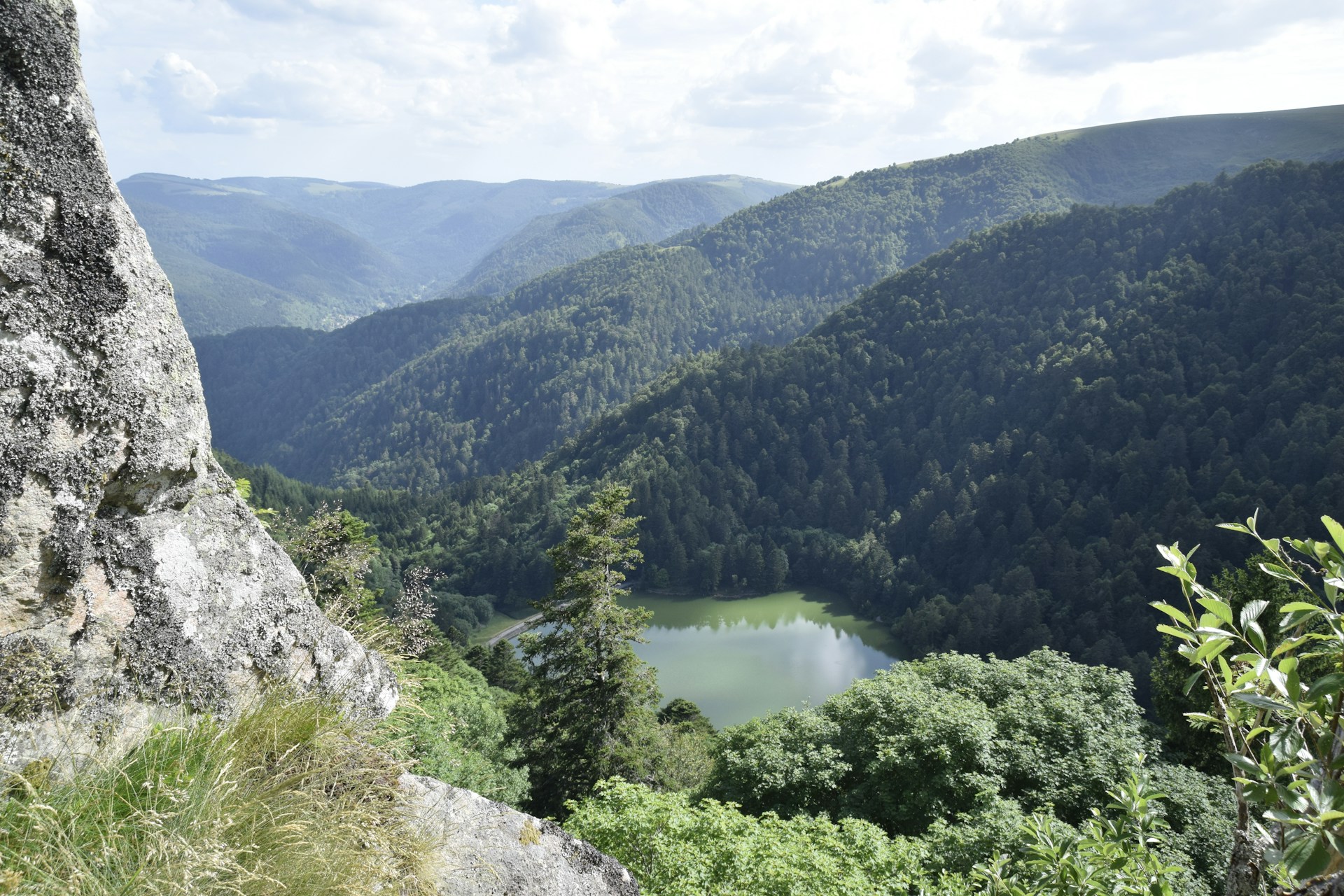
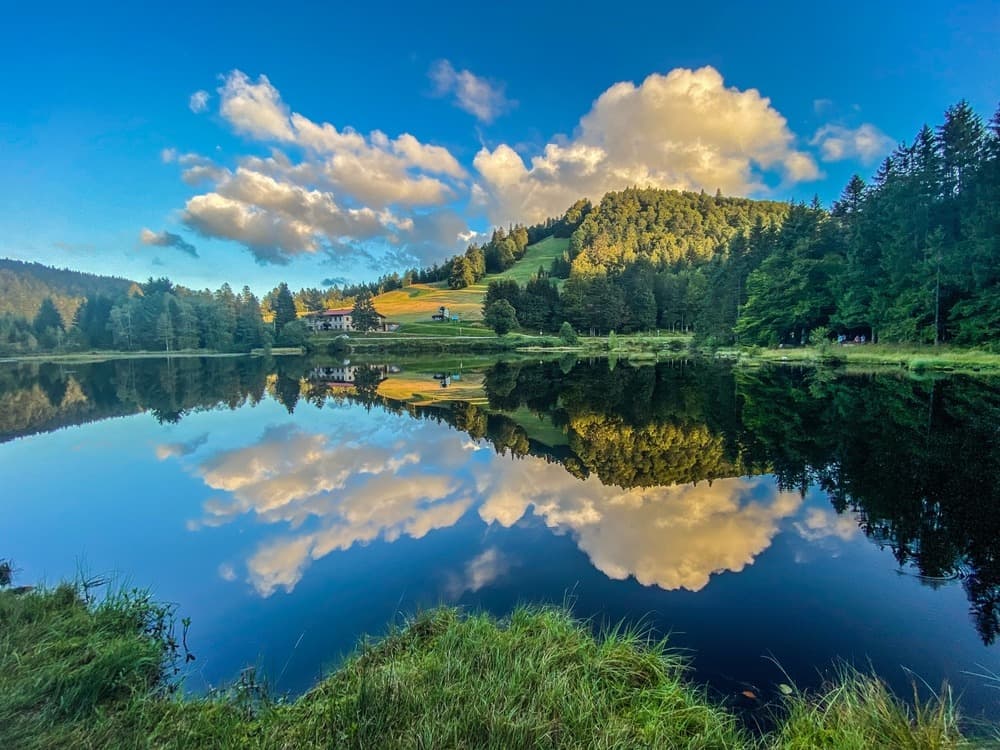
The Vosges combine several distinct atmospheres. The chaumes — open highland meadows — alternate with dense forests of beeches and firs. The Vosges lakes (Gérardmer, Longemer, Retournemer) occupy basins carved out by glaciers. The ballons, rounded peaks, dominate the landscape: the Ballon de Guebwiller (Grand Ballon, 1,424 m) is the highest summit of the range. On the built heritage side, ruins of medieval fortified castles dot the peaks, and the Alsatian villages below display their colorfully half-timbered houses.
History and context
The massif long marked the frontier between France and German states, then between France and Germany after 1871. The Ridge Road was built during the First World War to mask the movements of French troops from German observers. This border history explains the dual Alsatian-Lorraine identity of the massif, visible in architecture, gastronomy and local dialects. The Lorraine salt mines and historic glassworks testify to an ancient industry linked to forest resources.
Highlights of a visit
The Ridge Road
This scenic route runs along the Vosges peaks for approximately 80 km between Cernay and Sainte-Marie-aux-Mines. Viewpoints succeed one another: Markstein, Grand Ballon, Hohneck (1,363 m). On clear days, views extend to the Bernese Alps. The road is navigable by car, bicycle or on foot depending on the sections.
Lake Gérardmer
The largest natural lake in the Vosges, Gérardmer is surrounded by forests and accessible from the town of the same name. Swimming, pedalos, kayaking and lakeside trails occupy visitors in summer. The town hosts an international fantastic film festival every January.
Ballon d'Alsace
Southern peak of the massif (1,247 m), the Ballon d'Alsace marks the meeting point between Alsace, Lorraine and Franche-Comté. The hike from Saint-Maurice-sur-Moselle is a classic. A statue of the Virgin and a First World War memorial stand on the summit.
Alsatian piedmont villages
Ribeauvillé, Riquewihr, Kaysersberg and Thann are strung along the foot of the Alsatian slope. Their medieval streets, vineyards and Christmas markets make them natural stops on a Vosges circuit.
Photography tips
Early morning raking light on the meadows gives golden hues to highland prairies. Autumn (mid-October) offers a palette of rust and gold in beech forests. For lakes, favor sunrise: morning mists create reflections on the water. On the Ridge Road, panoramas toward Alsace are best in the afternoon, facing the setting sun in the west.
Location and access
The Vosges massif extends across the departments of Vosges (88), Haut-Rhin (68), Bas-Rhin (67) and Moselle (57). The main entry points are Strasbourg and Colmar on the Alsatian side, Épinal and Saint-Dié-des-Vosges on the Lorraine side. Colmar railway station allows quick access to the wine-growing piedmont and the first passes. From Paris, the TGV journey to Strasbourg takes approximately 1 hour 45 minutes.
Nearby attractions
- Colmar — Alsatian capital at the foot of the Vosges, known for its medieval center and Venice-like quarter.
- Strasbourg — Alsatian metropolis with its Gothic cathedral and the Petite France district.
- Alsace Wine Route — Wine route running along the Vosges piedmont from Marlenheim to Thann.
- Épinal — Prefecture of Vosges, known for its popular prints and its departmental museum of ancient and contemporary art.
- Gérardmer — Lake and ski resort, starting point for numerous hikes in the central Vosges massif.
Frequently asked questions
Summer (June–September) suits hiking and lake activities. Autumn offers the finest forest colors. Winter enables cross-country skiing and snowshoeing on the meadows, particularly around Markstein and Champ du Feu.
No. Certain sections of the D430 close in winter due to snow, notably between Grand Ballon and Markstein. Check conditions with Haut-Rhin road services before departure.
Yes, it's a classic circuit. The Alsatian slope descends directly onto wine villages. A day suffices to alternate a Vosges pass in the morning and a tasting in Riquewihr or Kaysersberg in the afternoon.
The Vosges ballons are accessible to beginner hikers: elevation gains remain moderate (300–500 m typically) and trails are well marked by the Club Vosgien. Hiking boots remain necessary.
Munster (PDO cheese aged in cellars), bilberry tart, Alsatian choucroute and Alsace wines (Riesling, Gewürztraminer) are the local references. Mountain farmhouses serve meals based on farm produce.
Yes. The lakes (Gérardmer, Longemer) offer calm water activities. Many marked discovery trails suit children. In winter, cross-country domains offer sledding runs and beginner-friendly ski trails.