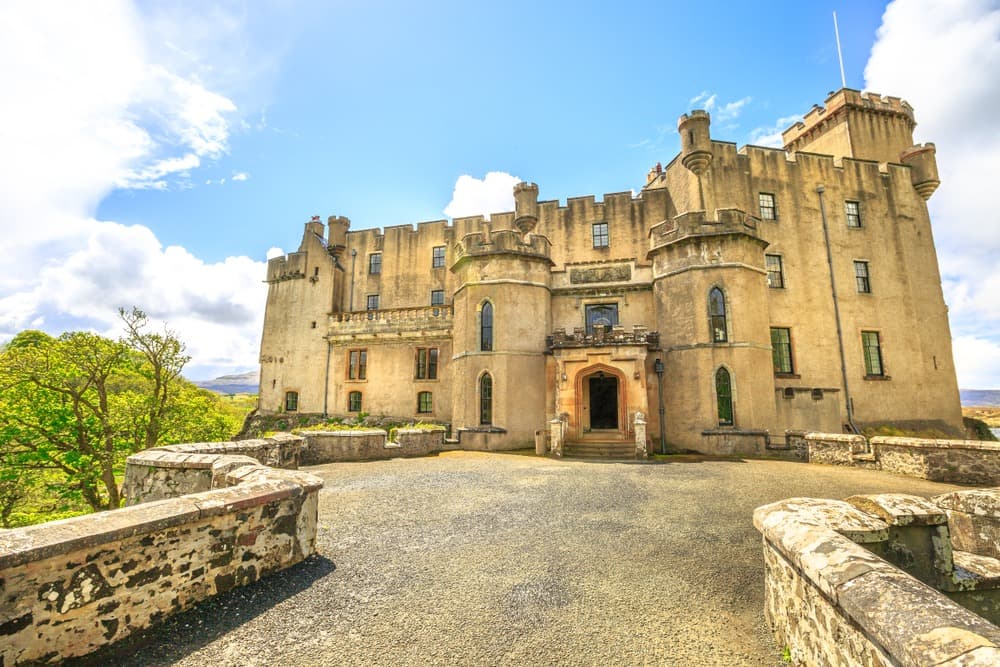
Dunvegan Castle and Gardens
Dunvegan Castle and Gardens
On the Isle of Skye, Dunvegan Castle is Scotland's oldest continuously occupied fortress, home to the MacLeod clan for eight centuries.
In the northwest of the Isle of Skye, Dunvegan Castle has dominated the loch of the same name for over eight centuries. The residence of the MacLeod clan chiefs, it is Scotland's oldest continuously occupied fortress. The visit combines the discovery of lived-in interiors, rare historical objects, and 5 hectares of landscaped gardens overlooking the loch.
Why visit Dunvegan Castle
Three elements distinguish Dunvegan from other Scottish castles. First, its continuity of occupation: the MacLeod family has resided here since around 1200, even before the Hebrides were joined to Scotland. The word "Dun" is a Nordic term denoting a fort, witness to the region's Viking origins.
Second, its collections: the Fairy Flag, the medieval Dunvegan Cup, relics attributed to Charles Edward Stuart and Flora MacDonald are preserved here. Finally, its setting: a loch rich in marine fauna, landscaped gardens, and a cinematic backdrop that notably served as the setting for the film Highlander starring Christopher Lambert.
History: eight centuries of MacLeod continuity
The castle's existence dates back probably to around 1200, when the Hebrides were still part of the Nordic kingdom. The building was constructed in six successive stages, from 1300 until the mid-1800s, and underwent at least ten periods of restoration between 1200 and 1850.
The homogeneous appearance the exterior presents today is the result of a restoration campaign undertaken in the 1840s, which unified heterogeneous structures under a neo-Gothic silhouette. The earthen bridge leading to the columned portico was added in 1814 by John Norman, 24th clan chief.
The castle has been open to the public since 1933. Despite successive alterations, it has retained its role as a family residence and its lived-in character, which sets it apart from more rigid fortress-museums.
What to see during your visit
The Fairy Flag
This silk banner, kept in the main reception room, is the castle's most famous object. According to clan tradition, when deployed in battle, it would invariably assure victory to the MacLeods. Its exact origins remain debated by historians (Oriental relic, Nordic standard).
The Dunvegan Cup and historical objects
The Dunvegan Cup is a medieval mazer given by the O'Neils of Ulster to Sir Rory Mor in gratitude for his support. The display cases also feature a waistcoat and lock of hair attributed to Charles Edward Stuart, as well as objects that belonged to Flora MacDonald, who aided the prince in fleeing after the defeat at Culloden.
The rooms and Fairy Tower
The route passes through the Fairy Tower, the reception room, the library, the old keep of the fosse, and the lower quarters where servants once worked. Oil paintings, silverware, and clan swords punctuate the rooms.
The 5-hectare gardens
Laid out in the 19th century, restored in 1974 and again in 1986, the gardens follow the British landscaped garden style: flower beds, ponds, streams, and woodland. They take advantage of the temperate microclimate of the west coast to host varied flora, sometimes unexpected at this latitude.
Loch Dunvegan and its wildlife
Boat cruises are available from late March to late September, weather permitting. The loch is home to saithe, mackerel, and coalfish, as well as a seal colony, nesting herons, and white-tailed eagles (erne). The outings allow for a peaceful approach to this wildlife.
Practical information
- Opening season: April to mid-October. The castle closes in winter.
- Duration of visit: allow 1.5 to 2 hours for the castle and gardens, longer if you add a loch cruise.
- Admission fees: combined ticket for castle and gardens at moderate rates, additional charge for boat outings. Reduced rates for children. Check current prices on the official website before your visit.
- Accessibility: the ground floor and gardens are largely accessible; the upper floors feature narrow stairs typical of medieval castles.
When to visit
The tourist season runs from April to October, corresponding to the site's opening window. May-June and September offer a good balance of daylight, blooming gardens, and moderate crowds. July-August see peak visitor numbers; cruises are most regular but attendance is higher. Skye's weather remains unpredictable in all seasons: pack waterproof clothing and windproof layers.
How to get there
The castle is located at the intersection of the A850 and A863, approximately 2 km north of the village of Dunvegan, in the northwest of Skye. A car remains the most practical way to reach the site.
- From Inverness: route via the A82 then A887 to Kyle of Lochalsh, then the Skye Bridge. Approximately 200 km.
- From Fort William: via the A82 and A87 to Kyle of Lochalsh, approximately 100 km.
- From the Skye Bridge (Kyle of Lochalsh): approximately 70 km northwest across the island to reach Dunvegan.
Bus services connect Portree to Dunvegan, but their frequency is limited outside the season.
Nearby attractions
Skye lends itself to a stay of several days. From Dunvegan, you can explore the Duirinish peninsula, the Coral Beaches, the Trotternish peninsula (Old Man of Storr, Quiraing), or Portree, the island's main town. To extend a Scottish circuit, the Glenmorangie distillery on the east coast complements a visit to the Highlands nicely. In Edinburgh, Holyrood Palace, the National Museum of Scotland, and the urban stroll along the Royal Mile offer an urban counterpoint to Skye's natural landscape.
Frequently asked questions
Frequently asked questions
Including Dunvegan in a Scottish journey
Dunvegan Castle naturally fits into an itinerary combining Edinburgh, the Highlands, and the Isle of Skye. To plan a stay that brings together clan heritage, coastal landscapes, and historic cities, consult our suggestions for Scottish travel.
Interested in this visit?
We can include it in your personalised itinerary.