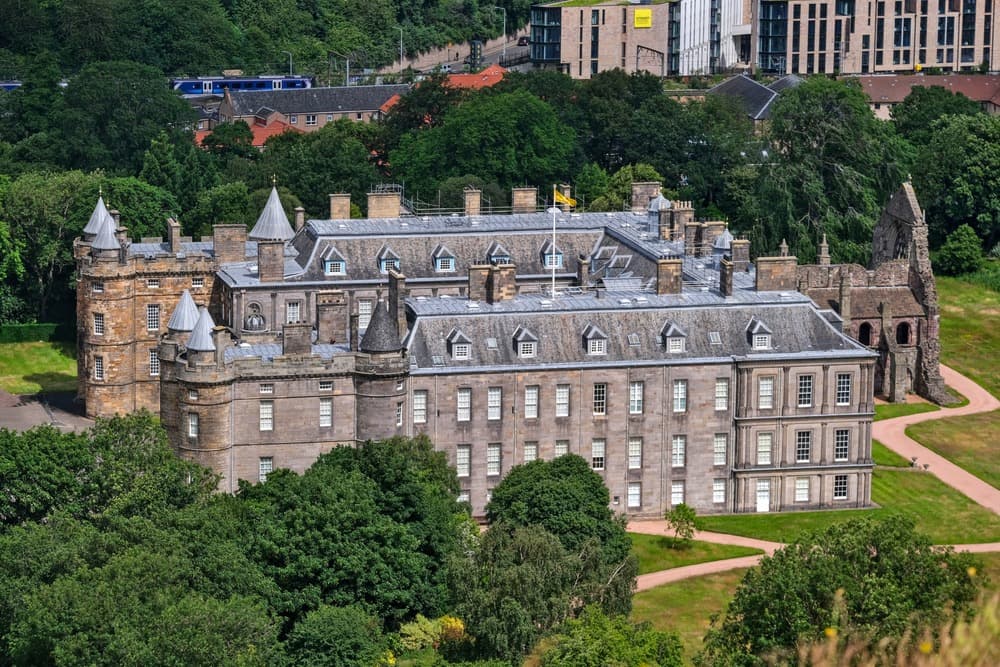
Holyrood Palace
Holyrood Palace
A royal residence at the foot of the Royal Mile, Holyrood Palace traces nine centuries of Scottish history, from the 1128 abbey to Mary Queen of Scots' apartments.
Holyrood Palace, or Holyroodhouse, is the official residence of British sovereigns during their stays in Scotland. Located at the foot of the Royal Mile, at the opposite end from Edinburgh Castle, it opens most of its state apartments to the public when the royal family is not in residence. The building encompasses nearly nine centuries of history, from the medieval monastery that preceded it to its current role as the setting for official Scottish ceremonies.
Why visit Holyrood Palace
Holyrood brings together the major chapters of Scotland's history on a single site: the ruined medieval abbey, Mary Queen of Scots' apartments, rooms reconstructed in the 17th century, and a Great Gallery whose royal portraits witnessed the country's political life until the 20th century. The visit also reveals how an active royal residence operates today, making it a natural complement to Edinburgh Castle.
History
The site was born in 1128, when David I of Scotland commissioned the construction of an Augustinian monastery. The abbey soon became a setting for royal ceremonies and hosted weddings, coronations and funerals. James II was born there in 1430; he was also crowned, married and buried there.
Construction of the palace itself began in 1498 under James IV, next to the abbey. A north-west tower was added between 1528 and 1536 under James V: these were the apartments occupied by Mary Queen of Scots. The palace was the scene, on 9 March 1566, of the murder of David Rizzio, the queen's Italian secretary, assassinated before her eyes at the instigation of her husband Henry Stuart, who accused him of adultery.
In 1603, James VI became king of Scotland and England and established his court in London: Holyrood lost its status as a permanent residence. During the Wars of the Three Kingdoms, troops under Oliver Cromwell caused a fire in 1650. Under Charles II, Scottish architect William Bruce oversaw a comprehensive reconstruction between 1671 and 1679, which gave the palace its present appearance, organized around a central quadrangle in classical style over three storeys.
Under James VII, the abbey was converted into a chapel for the Order of the Thistle, before being ravaged during a riot in 1688. At the turn of the 19th century, the Comte d'Artois, younger brother of Louis XVI, found refuge there after the French Revolution with the consent of George III; he returned in exile from 1830 to 1832. Since the opening of the Scottish Parliament in 1999, the palace has regularly hosted official stays by Charles III and Princess Anne.
What to see
The State Apartments
The tour passes through a succession of furnished rooms, adorned with tapestries and royal portraits. In the east wing, the king's chamber retains a particularly elaborate sculpted plaster ceiling, characteristic of Bruce's work.
The Great Gallery
The palace's most monumental room displays portraits of over a hundred Scottish kings, commissioned in the late 17th century from Flemish painter Jacob de Wet. This was the venue, until 1963, for the election of peers representing Scotland in the House of Lords. The gallery now serves for official receptions.
Mary Queen of Scots' Tower
The north-west tower, accessible to visitors, houses the former queen's apartments. Here you can see the cabinet where Rizzio was killed, as well as an exhibition devoted to the clothes and jewels of the period.
The Abbey and Gardens
The open-air ruins of Holyrood Abbey adjoin the palace and give an idea of its medieval grandeur. The gardens surrounding the whole feature a remarkable rose collection and open onto Holyrood Park, dominated by Arthur's Seat.
Practical Information
- Visit duration: Allow 1.5 to 2 hours for the apartments, abbey and gardens.
- Audio guide: Included with your ticket, available in French.
- Admission: Moderate full-price ticket, free for young children, discounts for students and seniors. Check current prices before your visit.
- Opening hours: Open year-round, with extended hours in summer and reduced hours in winter. The palace closes during royal stays; consult the official calendar before booking.
- Booking: Recommended during peak season, as access is regulated.
When to Visit
The palace can be visited year-round. From April to October, opening hours are at their widest and the gardens reach full bloom, particularly the rose garden in June-July. The summer season (July-August) coincides, however, with Royal Week, when the sovereign resides at the palace: access to the State Apartments is then closed for several days. May, September and October offer a good balance between daylight, gardens and reasonable crowds.
How to Get There
The palace is located at the eastern end of the Royal Mile, about twenty minutes' walk from Waverley Station or from the castle. Several Lothian Buses lines serve the area around the Scottish Parliament and Abbeyhill, a few minutes' walk from the entrance. No parking is provided for visitors: opt for walking or public transport from central Edinburgh.
What to See Nearby
- The Scottish Parliament, directly across from the palace, a work by architect Enric Miralles inaugurated in 2004.
- Holyrood Park and Arthur's Seat, an extinct volcano whose ascent takes about an hour and offers a panorama of the city.
- The Royal Mile, which links Holyrood to Edinburgh Castle while traversing the old town.
- Edinburgh Castle, at the other end of the Royal Mile, an obvious historical complement.
Frequently Asked Questions
Frequently asked questions
Include Holyrood in Your Itinerary
A visit to Holyrood fits naturally into a stay in Edinburgh, alongside the castle and a walk along the Royal Mile. To plan a bespoke itinerary combining the capital, the Highlands and the islands, consult our trips to Scotland.
Interested in this visit?
We can include it in your personalised itinerary.