Edinburgh Castle
Edinburgh Castle
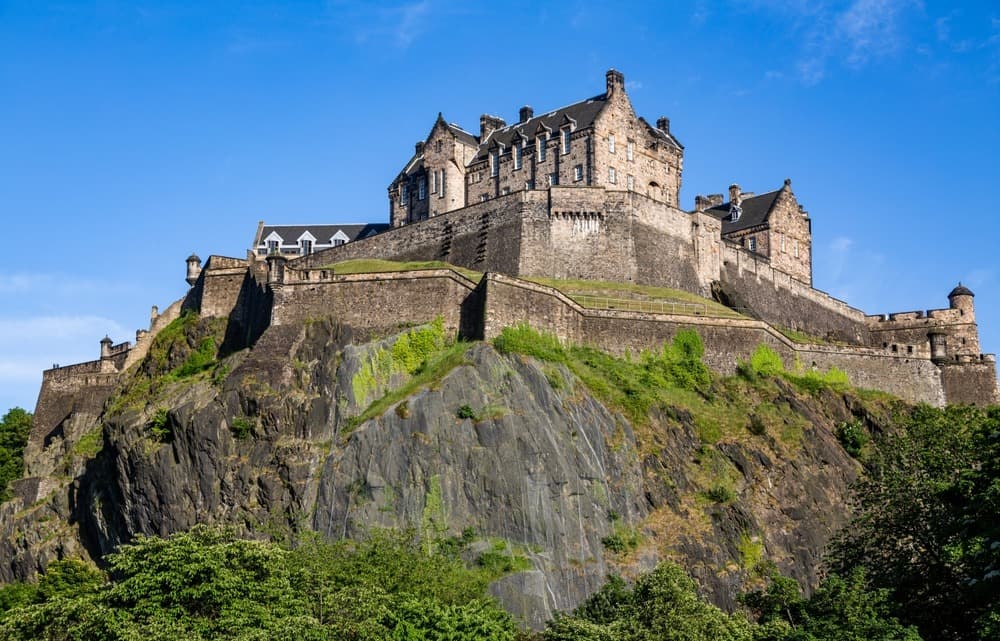
Perched on Castle Rock, Edinburgh Castle concentrates nearly a thousand years of military and royal history, from the Crown Jewels to the Military Tattoo.
Perched on Castle Rock, a volcanic crag approximately 350 million years old, Edinburgh Castle dominates Scotland's capital. The fortress encompasses nearly a thousand years of military and royal history, and remains one of Scotland's most visited heritage sites.
Why visit Edinburgh Castle
- Panoramic views across the entire city and the Firth of Forth from the ramparts.
- The Honours of Scotland, rediscovered in a sealed chamber in 1818.
- St Margaret's Chapel, Edinburgh's oldest surviving building.
- The medieval cannon Mons Meg and the National War Museum of Scotland.
- The Esplanade, which hosts the Edinburgh Military Tattoo each summer.
A thousand years of history
The rock has been occupied for a very long time: excavations attest to human presence dating back at least to the Bronze Age. The site is believed to be where the Votadini surrendered to the Romans in the 2nd century. The first written mention of the castle appears only in the 14th century, in a work by John of Fordun, but significant modifications are attributed to David I of Scotland from the 12th century onwards.
In 1333, the invasion led by Edward III of England results in English occupation until 1341, when William Douglas recaptured the stronghold for the Scots. Following the Wars of Independence, under David II, the castle is extensively rebuilt and gradually becomes an arsenal, with Holyrood Palace taking over as the principal royal residence.
In the 16th century, Mary, Queen of Scots finds refuge with William Kirkcaldy, the castle's keeper, after her escape. In 1573, James Douglas replaces Kirkcaldy and seeks the assistance of Elizabeth I of England, triggering a new siege and heavy bombardment.
Transformations continue: in the 1720s, additions of north and west bastions; during the Seven Years' War and the American War of Independence, construction of buildings intended for prisoners. In 1818, Sir Walter Scott gains permission to excavate the castle and rediscovers the Honours of Scotland, forgotten in a sealed chamber. Four years later, George IV visits in 1822, becoming only the second monarch to visit the castle after Charles II in 1651.
What to see on site
The Esplanade and entrance
Access is from the east, the only side that does not drop away as cliffs. The Esplanade, a sloping parade ground, serves as the stage for the Edinburgh Military Tattoo each summer. Beyond it, a dry moat and the entrance gate, flanked by statues of Robert I (Robert the Bruce) and William Wallace, mark the threshold of the fortress.
Military buildings
- The Governor's House, dating from 1742, which also housed the storekeeper and master gunner.
- Barracks from the late 18th century, designed for 600 soldiers.
- The military prison of 1842, which remained in service until 1923.
- A munitions store built in 1747-48, converted into a military hospital in 1897.
- The National War Museum of Scotland, part of the National Museums of Scotland.
Upper Ward and Crown Square
The Upper Ward, the rock's highest point, houses St Margaret's Chapel, Edinburgh's oldest building, and the siege cannon Mons Meg (15th century). To the east, the Half Moon Battery, built between 1573 and 1588, testifies to the 16th-century sieges.
Crown Square (or Palace Yard), created during the reign of James, is the main courtyard. It is surrounded by the Royal Palace to the east (which houses the Honours of Scotland and the Stone of Destiny), the Queen Anne Building to the west, the National War Memorial to the north, and the Great Hall to the south.
Practical information
- Visiting time: allow 2 to 3 hours to tour the entire site at leisure.
- Admission: paid entry, with reduced rates for children and seniors. Online booking strongly recommended to avoid queues.
- Opening hours: open year-round, with extended hours during peak season and shorter hours in winter. Final admission occurs approximately one hour before closing.
- Audio guide available in multiple languages and guided tours included with admission.
- Accessibility: steep terrain and cobblestones; a mobility vehicle operates from the Esplanade.
When to visit
The castle can be visited year-round. Spring and early autumn offer a good balance between pleasant weather and manageable crowds. Summer is peak season: July and August concentrate the majority of visitors, but this is also the season of the Edinburgh Military Tattoo, held on the Esplanade in August during the Edinburgh Festival. During this month, certain areas of the castle may be affected by stand construction. In winter, visitor numbers drop and the low-angle light particularly enhances the fortress's silhouette.
How to get there
- On foot: the castle sits at the top of the Royal Mile, a 10-15 minute walk from Waverley Station.
- By train: alight at Waverley (central station) or Haymarket, then continue on foot.
- By bus or tram: numerous routes serve Princes Street or George IV Bridge, a short distance from the Esplanade.
- From the airport: Edinburgh's tram links the airport to the city centre in 30-40 minutes.
Driving is not recommended: the historic centre is largely pedestrian and parking is limited.
What to see nearby
The castle is an ideal starting point for exploring Edinburgh's old town. In the immediate vicinity:
- The Royal Mile, the historic thoroughfare connecting the castle to the palace.
- Holyrood Palace, the official residence of the monarchy in Scotland.
- The National Museum of Scotland, a 10-minute walk away, free admission and highly recommended.
Frequently asked questions
Frequently asked questions
Allow 2 to 3 hours to tour the main buildings (Honours of Scotland, St Margaret's Chapel, Great Hall, National War Museum). History enthusiasts can easily spend half a day here.
Yes, it is strongly recommended, especially during peak season (June to September). Online booking helps you avoid sometimes lengthy queues at the ticket office.
The military festival runs annually in August on the castle's Esplanade, alongside the Edinburgh Festival. Tickets are reserved several months in advance.
The site features steep slopes and numerous cobblestones. A complimentary mobility vehicle provides access from the Esplanade up to Crown Square. Some historic buildings, including St Margaret's Chapel, remain difficult to access.
They are displayed in the Royal Palace on Crown Square, alongside the Stone of Destiny. These are the oldest surviving royal regalia held in Great Britain.
Including the castle in your visit
Edinburgh Castle fits naturally into a trip combining the capital, the Lowlands, and the Highlands. To build a bespoke itinerary, explore our Scotland travel ideas.
Interested in this visit?
We can include it in your personalised itinerary.