Hunawihr
Hunawihr
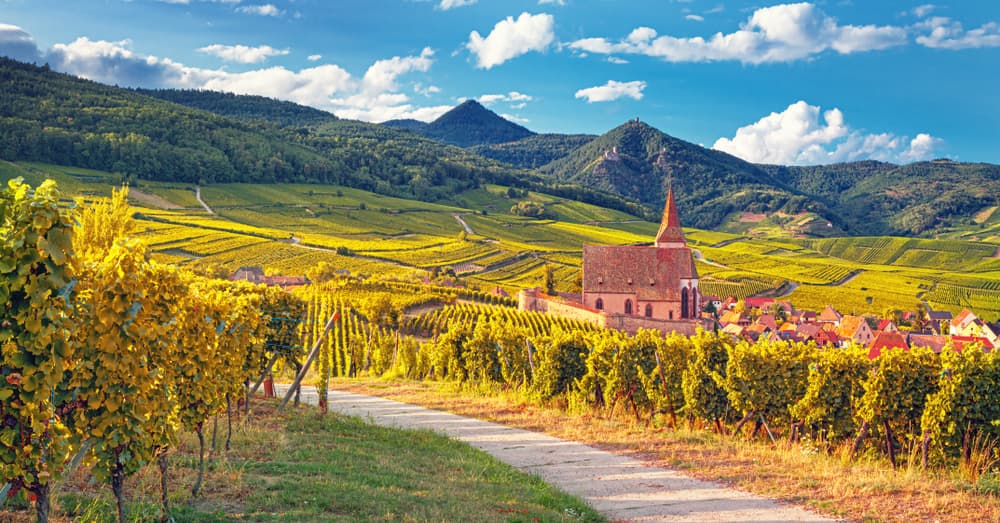
Hunawihr brings together a fortified church with a shared cemetery, the Grand Cru Rosacker vineyard, and a center dedicated to Alsatian storks—a compact village dense with history on the Wine Route.
Hunawihr is an Alsatian wine village nestled between Ribeauvillé and Riquewihr, along the Alsace Wine Route. Its Grand Cru Rosacker vineyards, its 16th-century fortified church, and its stork reintroduction center make it a remarkably rich stop despite its modest size. The village is among the Most Beautiful Villages in France.
Practical Information at a Glance
- Access: car recommended; parking at the village entrance. Nearest train station: Colmar (approximately 15 km away).
- Suggested duration: 2 to 3 hours for the village, church, and stork center.
- Stork Reintroduction Center: admission fee; open March to November (verify exact dates on-site or on the official website).
- Saint-Jacques-le-Majeur Church: free exterior access; interior open during services.
- Accessibility for visitors with reduced mobility: cobblestone streets, limited access in some alleyways.
What to See
The village revolves around three focal points. The fortified church of Saint-Jacques-le-Majeur, perched on a promontory, is surrounded by a cemetery serving both Catholic and Protestant communities—an exceptionally rare arrangement in Alsace. The Grand Cru Rosacker vineyards descend in terraces to timber-framed houses. The Stork and Otter Reintroduction Center welcomes species undergoing rehabilitation in the region.
History and Context
Hunawihr is mentioned as early as the 7th century. Legend attributes the church's foundation to Saint Hune, wife of a local lord. Following the Reformation, Catholics and Protestants shared the building—a practice called simultaneum—for several centuries. The cemetery fortifications date from the 16th century, built to protect villagers during the Wars of Religion.
Highlights of Your Visit
The Fortified Church and Shared Cemetery
The hexagonal enclosure with six bastion towers is among the best-preserved in Alsace. Inside, 14th-century Gothic frescoes depicting the life of Saint Hune are partially visible on the walls. The panorama of vineyards from the church forecourt is remarkable.
The Grand Cru Rosacker
This clay-limestone terroir produces primarily Riesling and Gewürztraminer. Several wine estates in the village offer tastings; contact local producers directly for reception hours.
The Stork and Otter Reintroduction Center
Founded in the 1970s, this center played a key role in the return of white storks to Alsace. Cormorant fishing demonstrations and otter pools complement the visit, particularly enjoyed by families.
Etiquette and Visiting Rules
- The church is an active place of worship: observe silence and dress appropriately inside.
- The cemetery remains in active use: respect the tranquility of the grounds.
- Do not enter the vineyards except along marked pathways.
Photography Tips
The golden light of late afternoon on the vineyards and church is optimal in summer. From the church forecourt, the framing encompasses vineyard rows and the steeple in a single shot. In May-June, storks nest on village rooftops—an easily captured subject from the main street.
Location and Access
Hunawihr is located in Haut-Rhin (Alsace), approximately 4 km from Ribeauvillé and 3 km from Riquewihr. The Alsace Wine Route runs directly through the village. Colmar, the region's main rail hub, is accessible by car in about twenty minutes. No regular frequent bus service: car or bicycle remain the most practical options.
In the Surrounding Area
- Riquewihr — a fortified medieval village, one of the most visited in Alsace, just minutes by car.
- Ribeauvillé — a lively town dominated by three ruined castles on the Vosges heights.
- Kaysersberg — birthplace of Albert Schweitzer, featuring a medieval castle and dense historic center.
- Colmar — capital of Alsace wines, with Little Venice and the Unterlinden Museum.
- Bergheim — a less-frequented fortified village with nearly intact ramparts.
Frequently asked questions
May through October, when vineyards are in growth and the Stork Center is open. The harvest season (September-October) offers a special atmosphere in the Rosacker vineyards.
In practice, yes. Public transportation connections are limited. Cycling is a pleasant alternative from Ribeauvillé or Riquewihr on lightly trafficked roads.
Yes, the three villages are just kilometers apart. Allow a full day to visit all three without rushing, including a wine tasting.
Absolutely. The otter pools and cormorant fishing demonstrations are particularly popular with families and children.
The interior is accessible, though opening hours depend on services and the season. The exterior and fortified cemetery are freely accessible.
Several wine estates in the village offer direct tastings. For dining, Ribeauvillé and Riquewihr offer more choices in close proximity.
Want to discover this destination?
Our local advisors design your tailor-made trip.