Auvergne
Auvergne
Dormant volcanoes, crater lakes, Romanesque architecture and AOC cheeses: Auvergne offers a unique geological landscape in Western Europe, between wide open spaces and preserved medieval heritage.
Auvergne occupies the heart of the Massif Central, in southern France. Dormant volcanoes, crater lakes, spa towns and AOC cheeses: this region concentrates a unique volcanic geography in Western Europe. It attracts lovers of wide open spaces, hiking and Romanesque heritage, far from saturated tourist circuits.
Practical info at a glance
- Access: Clermont-Ferrand is the regional capital, served by TGV from Paris (around 3 hours) and Clermont-Ferrand Auvergne airport.
- Best time: May–October for hiking; winter for snow sports on the Sancy.
- Recommended duration: 5 to 7 days to cover the main massifs and towns.
- What to wear: hiking boots essential in the mountains; extra layers even in summer (altitude).
What you'll see
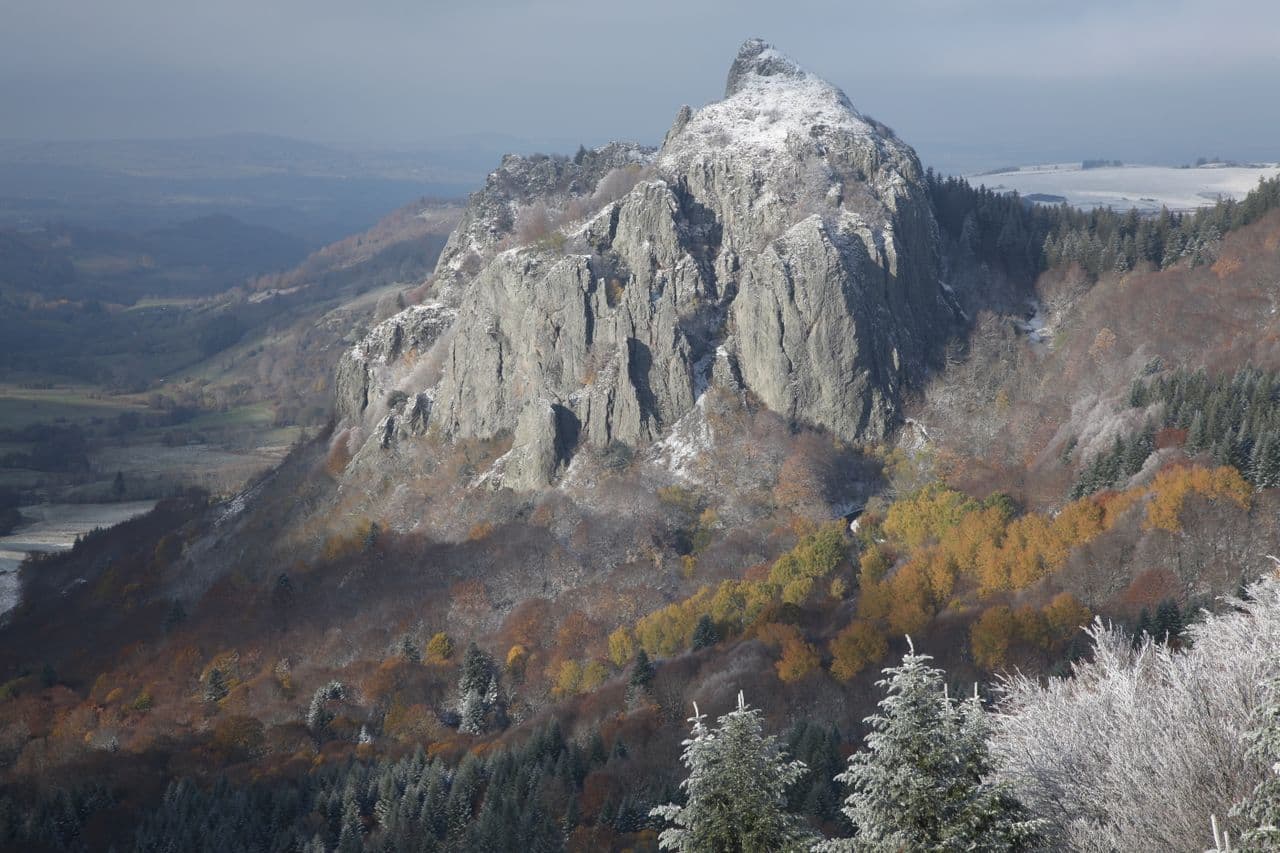
The Auvergne landscape is dominated by volcanoes: the Puys chain, Sancy massif, Cantal, Devès. The summits peak around 1,800 m. Between the volcanic cones stretch crater lakes (Pavin, Chauvet, Aydat lakes) with cold, crystalline waters. The Truyère and Allier gorges carve deep valleys.
The spa towns — Vichy, La Bourboule, Le Mont-Dore — preserve remarkable Belle Époque architecture. Clermont-Ferrand stands out for its Gothic cathedral built in black lava stone, unique in France.
History and context
Auvergne was a Gallic crossroads (the Arvernes people, from whom Vercingetorix emerged) before becoming a Roman province. In the Middle Ages, it developed a rich Romanesque art tradition: over 250 Romanesque churches remain, including the Notre-Dame-du-Port basilica in Clermont-Ferrand, inscribed on the UNESCO World Heritage list. The region was long isolated by its terrain, which preserved its pastoral and cheesemaking traditions.
Highlights of your visit
The Puys chain and Puy de Dôme
Inscribed on the UNESCO World Heritage list since 2018, the Puys chain lines up 80 volcanoes over 40 km. The Puy de Dôme (1,465 m) offers a panorama across the entire chain. A rack railway climbs there from Clermont-Ferrand.
The Sancy massif
The highest point of the Massif Central at 1,886 m, the Puy de Sancy is accessible by cable car from Le Mont-Dore. In summer, hiking trails cross flowered alpine meadows; in winter, ski slopes take over.
The Truyère gorges and Garabit viaduct
The Garabit viaduct, built by Gustave Eiffel in 1884, spans the Truyère gorges in the Cantal. The Grandval dam reservoir has created a 3,000-hectare lake ideal for water sports.
Vichy and spa architecture
Vichy preserves its thermal baths, parks and Belle Époque villas. The town is inscribed on the UNESCO World Heritage list within the "Great Spas of Europe" framework.
AOC cheeses
Auvergne produces five AOC cheeses: Saint-Nectaire, Cantal, Salers, Fourme d'Ambert and Bleu d'Auvergne. Local markets and alpine farms allow you to buy directly from producers.
Photography tips
Early morning raking light on the Puys chain, viewed from Puy de Dôme, reveals the volcanic cones with striking relief. Pavin lake, surrounded by forests, photographs best early in the morning before wind ripples the surface. Villages of black volcanic stone (Orcival, Besse-en-Chandesse) are photogenic in overcast weather, which softens contrasts.
Location and access
Auvergne today corresponds to the western part of the administrative region Auvergne-Rhône-Alpes. Clermont-Ferrand is the main entry point. The A71 connects Paris to Clermont-Ferrand, the A75 descends toward Montpellier by crossing the Cantal. The network of inter-city coaches (Flixbus, regional services) serves the main spa towns. In the mountains, a car remains essential.
Nearby
- Clermont-Ferrand — regional capital, cathedral in black lava stone and Notre-Dame-du-Port basilica.
- Vichy — Belle Époque spa town, UNESCO World Heritage site.
- Puy de Dôme — iconic summit of the Puys chain, accessible by rack railway.
- Puy de Sancy — highest point of the Massif Central, hiking and skiing.
- Orcival — medieval village and Notre-Dame d'Orcival Romanesque basilica.
- Issoire — Saint-Austremoine abbey church, masterpiece of Auvergne Romanesque art.
- Salers — fortified medieval town in the Cantal, birthplace of the Salers cattle breed.
Frequently asked questions
May to October for hiking and lakes. July-August are the busiest months on the summits. From December to March, the Sancy massif offers ski runs.
Yes, for the massifs and isolated villages. Clermont-Ferrand and Vichy are accessible by train, but natural sites (Puys chain, Pavin lake, Cantal) require a vehicle or organized tours.
Yes. A round-trip circuit from Clermont-Ferrand allows you to connect Puy de Dôme, Orcival, Issoire and Besse-en-Chandesse in 3 to 4 days.
No. Auvergne's volcanoes have been extinct for thousands of years. No eruption risk is recorded. Caution is only needed in case of stormy weather at altitude.
Markets in Clermont-Ferrand, Aurillac, Ambert and Issoire stock all five regional AOCs. Some alpine farms sell directly in summer; ask local tourism offices for details.
The Puy de Dôme rack railway is accessible to wheelchair users. Hiking trails at altitude, however, are poorly suited for those with reduced mobility.
Want to discover this destination?
Our local advisors design your tailor-made trip.