Vallorbe
Vallorbe
Vallorbe, in the Swiss canton of Vaud, combines spectacular caves traversed by the underground Orbe river, a World War II military fortress and an iron and railway museum — a full day of discovery in the Swiss Jura.
Vallorbe is a small town in the canton of Vaud, nestled in the Orbe valley at the French-Swiss border. A historic railway crossroads between France and Switzerland, it is best known for its spectacular caves, its iron and railway museum, and the landscapes of the Vaud Jura. The Orbe river has its visible source here, making it a natural starting point for exploring the Jura massif.
Practical information at a glance
- Access: direct railway station from Lausanne (Lausanne–Vallorbe–Paris line), approximately 40 minutes from Lausanne.
- Border: customs crossing to Pontarlier (France) a few kilometres away.
- Recommended duration: a full day to combine caves, museum and walks along the Orbe.
- Accessibility: the town centre is accessible; the caves feature stairs and narrow passages, poorly suited for wheelchairs.
What to see
Vallorbe concentrates several distinct sites. The Vallorbe Caves are the main attraction: an underground network traversed by the underground Orbe river, featuring stalactites, stalagmites and halls of impressive dimensions. The Iron and Railway Museum, housed in former forges, traces the metallurgical history of the region and the strategic role of the international railway line. Above ground, the Pré-Giroud Fort, a World War II military structure, is open to visitors and offers a glimpse of Switzerland's defensive system.
History and context
Vallorbe owes its development to two resources: iron and rail. Forges have exploited local ore since the Middle Ages, powered by the hydraulic force of the Orbe. In the 19th century, the opening of the Mont-d'Or tunnel (1915) made Vallorbe a major international hub on the Paris–Lausanne–Milan route. During World War II, the town became a closely monitored passage point and the Pré-Giroud fort was integrated into the Swiss national redoubt.
Highlights of the visit
The Vallorbe Caves
The guided tour descends into galleries carved by the underground Orbe. Limestone formations — columns, draperies, rimstone pools — have been forming for millennia. The river flows within the passage itself, creating a particularly striking atmosphere. Bring warm clothing: the underground temperature remains cool year-round.
The Iron and Railway Museum
Located in the former Grande Forges, the museum presents metalworking techniques and the history of the international railway line. Period machine tools and locomotive models captivate enthusiasts of industrial history.
The Pré-Giroud Fort
This underground military structure, built in the 1930s-1940s, houses cannons, galleries and reconstructed command posts. The guided tour sheds light on Switzerland's armed neutrality during World War II.
The source of the Orbe
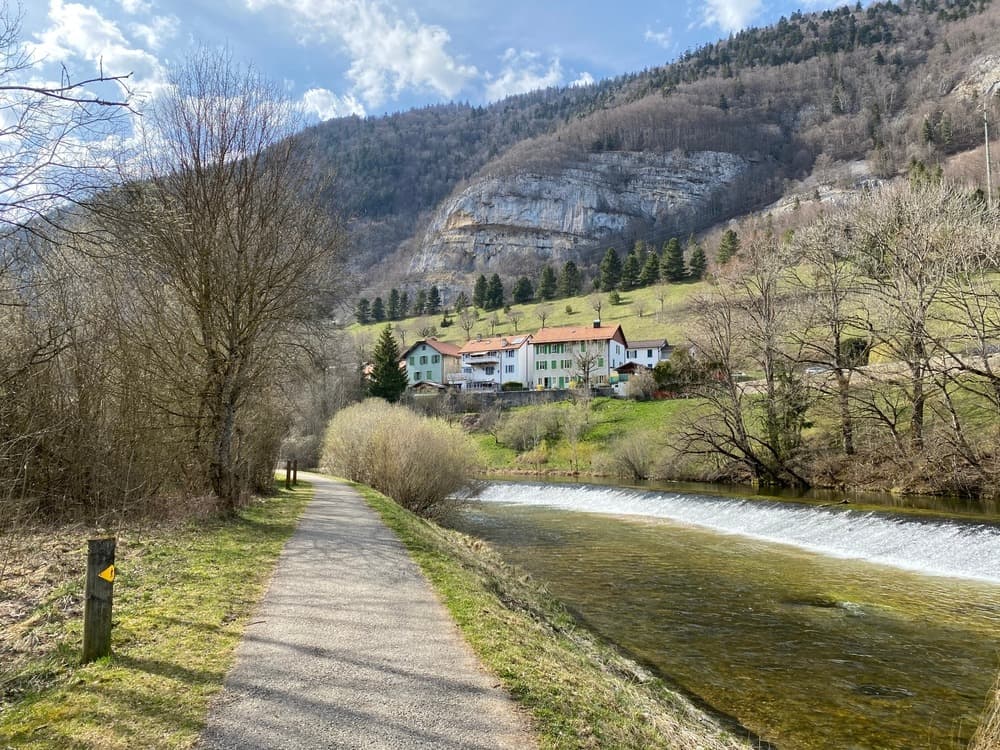
At the cave exit, the Orbe emerges into daylight. The footpath along the river offers a peaceful walk through wooded surroundings, ideal for extending your underground visit.
Photography tips
Photography is generally permitted in the caves without flash. A compact tripod greatly improves results in low light. Above ground, the golden light of late afternoon enhances the stone facades of the town centre and the banks of the Orbe. The fort lends itself well to black and white photography to emphasize its military atmosphere.
Location and access
Vallorbe is located in the Jura-Nord Vaud district, bordering the Doubs department (France). The station is served by CFF trains from Lausanne. By car, access is via the A9 motorway then cantonal roads. The caves and fort are accessible by shuttle or on foot from the centre depending on the season — check details with the local tourist office.
Nearby attractions
- Lac de Joux — a large Jura lake a few kilometres away, ideal for sailing, fishing and winter ice activities.
- Pontarlier — neighbouring French town, known for absinthe production and the château de Joux.
- Lausanne — the Olympic capital on Lake Geneva, approximately 40 minutes by train, with museums, Gothic cathedral and a lively old town.
- Yverdon-les-Bains — thermal spa town south of Lake Neuchâtel, with its medieval castle and baths.
Frequently asked questions
Spring and summer offer the best conditions for combining caves, fort and outdoor walks. In winter, the nearby Lac de Joux attracts ice sports enthusiasts, but check site openings before travelling.
During peak season, advance booking is recommended to avoid waiting. Check the caves' official website for available time slots.
The underground temperature is cool year-round. Bring a sweater or light jacket, even in summer, along with closed-toe shoes with non-slip soles.
Yes, with good planning: caves in the morning, iron museum in early afternoon, Pré-Giroud fort in late afternoon. Allow a full day without rushing.
Yes, the CFF station connects directly from Lausanne to Vallorbe. The caves and fort are accessible from the station, but walking distances are significant — inquire about seasonal shuttle services.
The caves and fort generally appeal greatly to children. The underground galleries and reconstructed military equipment stimulate curiosity. Check for any age restrictions with the sites.
Photos
Want to discover this destination?
Our local advisors design your tailor-made trip.