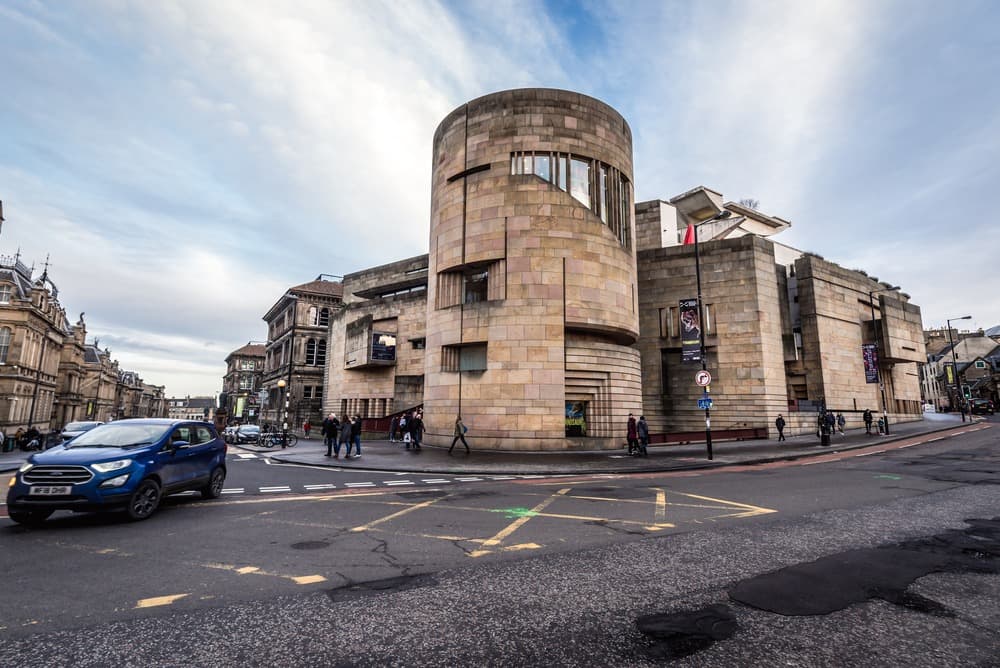
The National Museum of Scotland
The National Museum of Scotland
On Chambers Street in Edinburgh, the National Museum of Scotland brings together archaeology, science, fashion and world cultures across sixteen free galleries.
The National Museum of Scotland occupies two adjoining buildings on Chambers Street, in the Old Town of Edinburgh. With more than two million visitors in 2019, it ranks among the most visited cultural institutions in the United Kingdom outside London. Its galleries cover archaeology, Scottish history, natural sciences, technology, fashion and world cultures.
Why visit the National Museum of Scotland
The museum's appeal lies in the breadth of its collections: 8,000 objects displayed across sixteen galleries following the 2011 renovation, with 80% presented to the public for the first time on that occasion. Free access to the permanent collections makes it a practical anchor point for structuring a day in Edinburgh, particularly on rainy days.
Beyond sheer volume, the museum's identity rests on a few standout pieces. The taxidermied body of Dolly the sheep, the first mammal cloned from an adult cell, is displayed in the science galleries. The Millennium Clock, an animated sculpture-clock installed in the Grand Gallery, chimes every hour and remains one of the museum's most photographed objects.
Museum history
The current institution was born in 2006 from the merger of the Museum of Scotland, devoted to archaeology, culture and Scottish history, and the Royal Museum of Scotland, dedicated to science, technology and world cultures. The two adjacent buildings reflect this dual identity: the Royal Museum is housed in a Victorian structure dating from 1861, while the Museum of Scotland occupies a modern golden sandstone building opened in 1998.
The collections expanded over time with contributions from the former National Museum of Antiquities of Scotland. A major renovation, funded with a budget of 47 million pounds sterling, culminated in the reopening of the Royal Museum on 29 July 2011, accompanied by the unveiling of sixteen new galleries.
What to see in the galleries
The Grand Gallery
A logical starting point for your visit, this monumental space with cast-iron pillars offers an overview of the collection's diversity. The Millennium Clock forms its focal point.
Art, design and fashion galleries
These trace the evolution of clothing, textiles and interior decoration through the ages, with a dedicated section on designers and their methods.
Natural world galleries
Hundreds of taxidermied or reconstructed species, marine life, mammals and reptiles. Notable among them is a large skeleton (cast) of a Tyrannosaurus rex and educational displays on evolution.
Science and technology galleries
Interactive sections devoted to engineering, communication, energy and research, with a largely participatory component on the first floor. This is where Dolly the sheep is presented.
Scottish history and archaeology galleries
From prehistory to the industrial era, these rooms unfold the country's narrative through archaeological objects, pieces of metalwork and reconstructions of everyday life.
World cultures galleries
Three main collections: Southeast Asia, Ancient Egypt and Pacific Islands. The collections illustrate the connections between objects, rituals and societies.
The panoramic terrace
Located on the roof, it offers an unobstructed view of Edinburgh's rooftops, the castle and Arthur's Seat. Free access via the main lifts.
Practical information
- Address: Chambers Street, at the intersection with George IV Bridge, Old Town Edinburgh.
- Hours: open daily, generally 10am to 5pm. Check official hours before your visit, as they may vary on public holidays.
- Admission: free entry to permanent collections; some temporary exhibitions are ticketed and may require advance booking.
- Recommended duration: 3 to 4 hours for a representative visit. Allow a full day for an in-depth exploration.
- Accessibility: buildings equipped with lifts, disabled access to all galleries.
How to get there
The museum is located in the Old Town, about ten minutes' walk from Edinburgh Waverley station and immediately adjacent to the Royal Mile, with Chambers Street running parallel to it on the south. Several local bus lines serve George IV Bridge and South Bridge, a short walk from the entrance. By car, two nearby car parks are available: Q-Park on Chambers Street and NCP on Queen Street. Parking in the city centre remains expensive, and public transport is recommended.
Nearby attractions
- Edinburgh Castle — about ten minutes' walk via George IV Bridge.
- The Royal Mile — the historic thoroughfare connecting the castle to the palace.
- Holyrood Palace — the official Scottish residence of the Crown, at the other end of the Old Town.
Frequently asked questions
Frequently asked questions
Yes, access to the permanent collections is free. Only certain temporary exhibitions are ticketed and may require advance booking.
Allow 3 to 4 hours to explore the main galleries. Visitors interested in science or Scottish history can easily spend an entire day here.
Yes. The science and natural world galleries offer interactive displays, and several spaces are designed with families in mind.
On Chambers Street, in Edinburgh's Old Town, at the intersection with George IV Bridge. It runs parallel to the Royal Mile, about two minutes' walk to the south.
Yes, Dolly's taxidermied body is permanently displayed in the science and technology galleries.
Incorporating the museum into a Scottish journey
The National Museum of Scotland fits naturally into an Edinburgh stay combining urban heritage with excursions to the Highlands or distilleries. To plan a complete itinerary, explore our trips to Scotland.

Interested in this visit?
We can include it in your personalised itinerary.